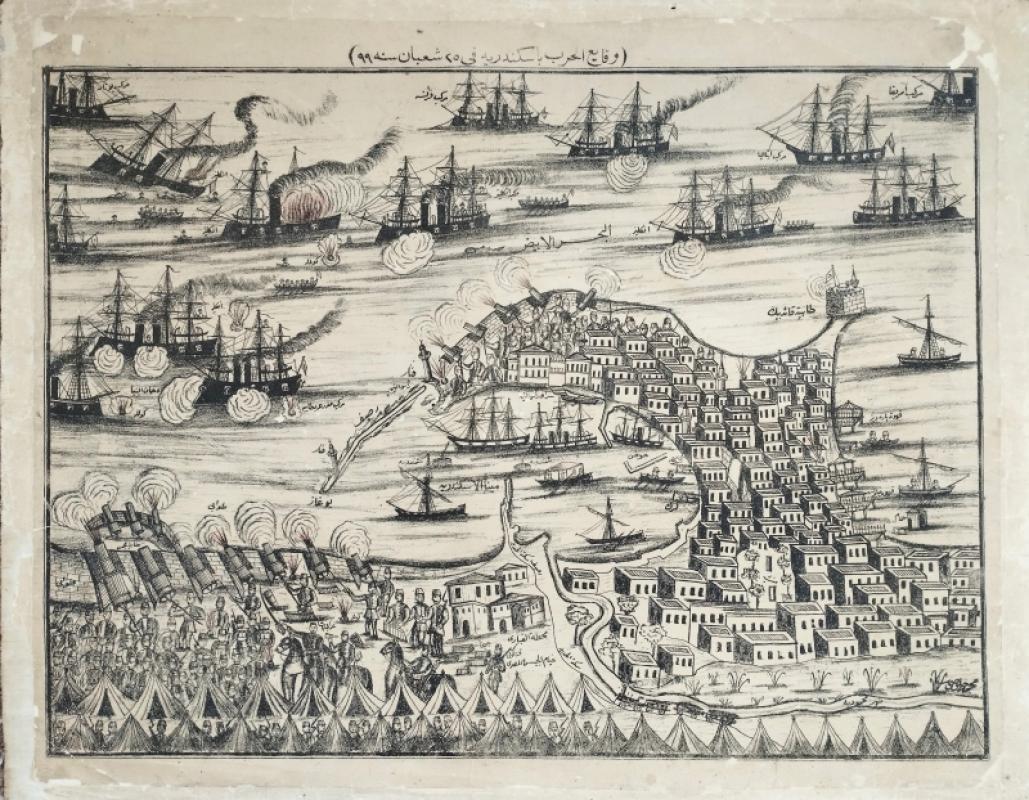
[The bombardment of Alexandria].
Book Description
Dealer Notes
Yet, Klousi also includes everyday details of the wider activities of the army. Soldiers are shown smoking and relaxing around a fire whilst Generals meander around the city on horseback. Another charming element is a munitions train. It is shown rattling along a track running adjacent to the El Mahmudiya canal.
Judged on this image alone, the Egyptian’s appear to be successfully defending Alexandria with the port showing a lack of damage. Meanwhile, one British ship has listed over and another is shown as being on fire. Several unharmed French ships are also identified observing the battle.
However, the reality was far bleaker for the rebelling Egyptians. As discussed by Schiller, "even though many of the British ironclad ships were hit, none were seriously damaged. On the other hand, the Egyptian casualties were in the hundreds and most of the forts and canons had been rendered useless after the bombardment."
Egypt was subjected to Imperialist interference throughout the 19th century. This coalesced around the building of - and subsequent strategic importance of - the Suez Canal.
Ismail Pasha's (1830-1895) had overstretched Egypt’s finances. This was caused by his ambitious modernisation projects in Cairo and failed expeditions into Africa. This nearly resulted in Egypt’s bankruptcy as they struggled to pay the interest on loans from France and Great Britain.
Separately, the English realised that the Suez Canal would threaten their monopoly of the trade route to India. With Pasha needing money urgently, the British were able to buy Egypt's shares in the Suez Canal in 1875 at a discounted rate. The Pasha also agreed to Britain and France controlling Egypt’s budget if they provided him with more finance.
This agreement caused local unrest and led to the election of a nationalist government in 1882. Governed by Ahmed Urabi (1841-1911), it demanded democratic reforms and that the Pasha returned the budget to local control. The Pasha rejected these demands and the British and French began to believe that Urabi may try to seize the Suez Canal. They decided to send expeditions to defend Tewfik Pasha’s sovereignty and safeguard their interests.
This led to the Anglo-Egyptian war of 1882. Following the attack on Alexandria, a combined force of British and French armies would finally defeat the Egyptian rebels at the Battle of Tel El Kebir.
Originally sentenced to death following the uprising, the British intervened to exile Urabi to Ceylon (Sri Lanka). Whilst there, he worked on improving the education of the Muslim population on the island until he was able to return to Egypt in 1901.
Urabi’s revolt is considered a defining moment in Egyptian political history. Muhammad Naguib and Gamel Nasser both referenced Urabi in speeches during their respective periods of power. Naguib reputedly recited 'Urabi's words to Khedive Tewfik that the people of Egypt were "no longer inheritable by any ruler" at a speech in Ismailia Square.
Rare. OCLC locates a single holding at the Royal Museums, Greenwich. That example shows later colouring and French transliterations of the Arabic around the borders, giving Klousi’s name (G235:14/13). Given its size and anti-Imperialist sentiment, this work is unquestionably a rare survival.
Inventory number: 750
Other books
If you liked the book you've just seen, you might be interested in other books from the same dealer below.
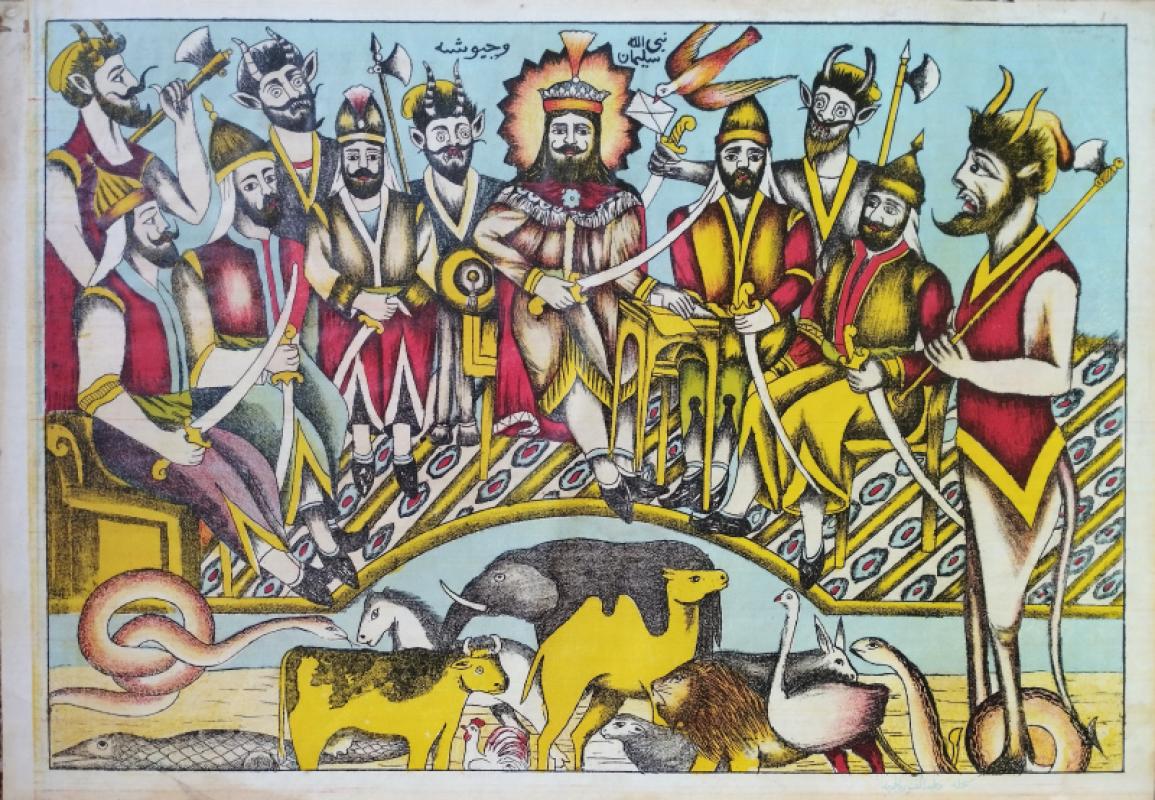
[Two Islamic devotional prints]
[FINE ARTS PRESS]
Fine Arts Press, Cairo
£1000.00
Offered by Peffers Rare Books Ltd.
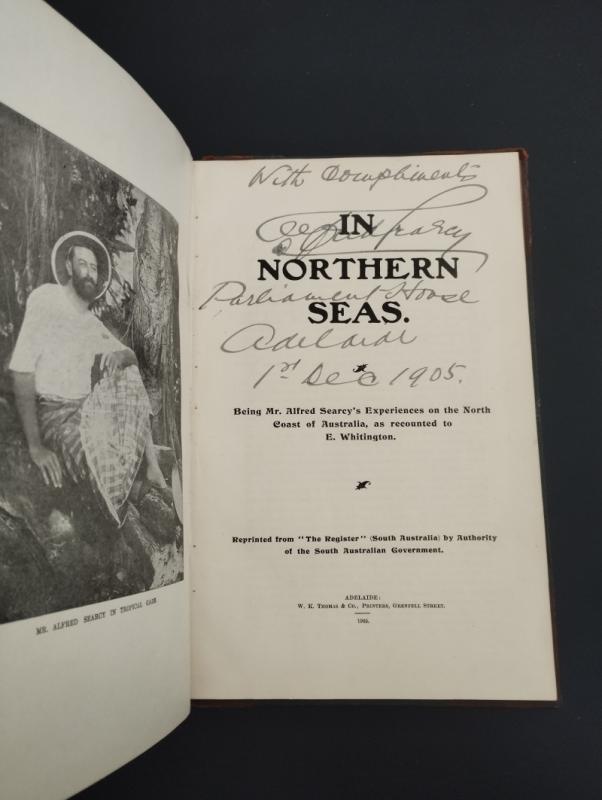
In northern seas. Being mr Alfred Searcy's experie...
SEARCY (Alfred)
Adelaide, By authority of the South Australian Government; W.K. Thomas & co. Printers.
£275.00
Offered by Peffers Rare Books Ltd.
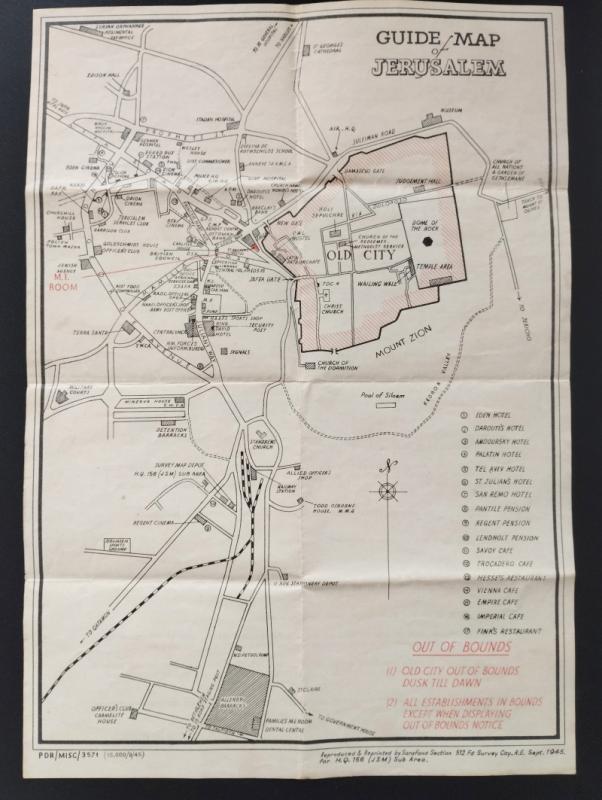
Guide Map of Jerusalem.
[ROYAL ENGINEERS] [PALESTINE]
Jerusalem; re-printed by the Sarafind section, 512 Fd. Survey Coy.RE.
£100.00
Offered by Peffers Rare Books Ltd.
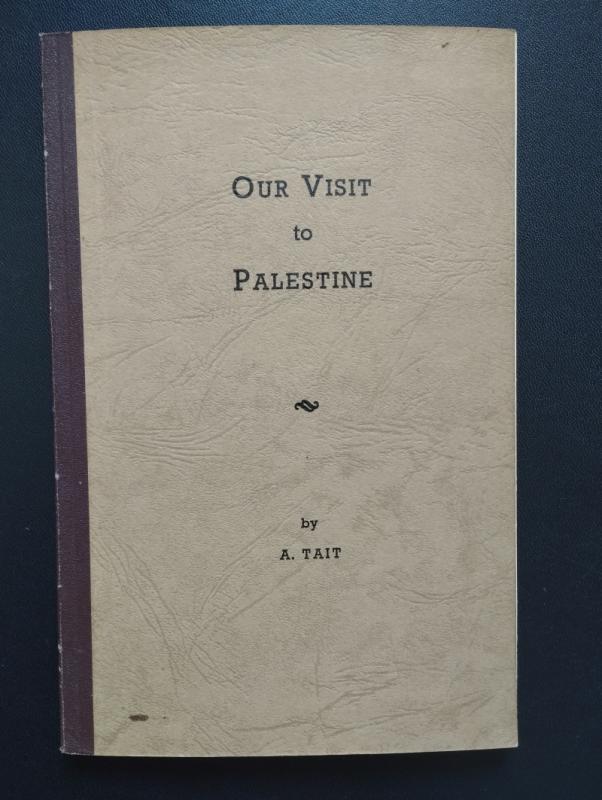
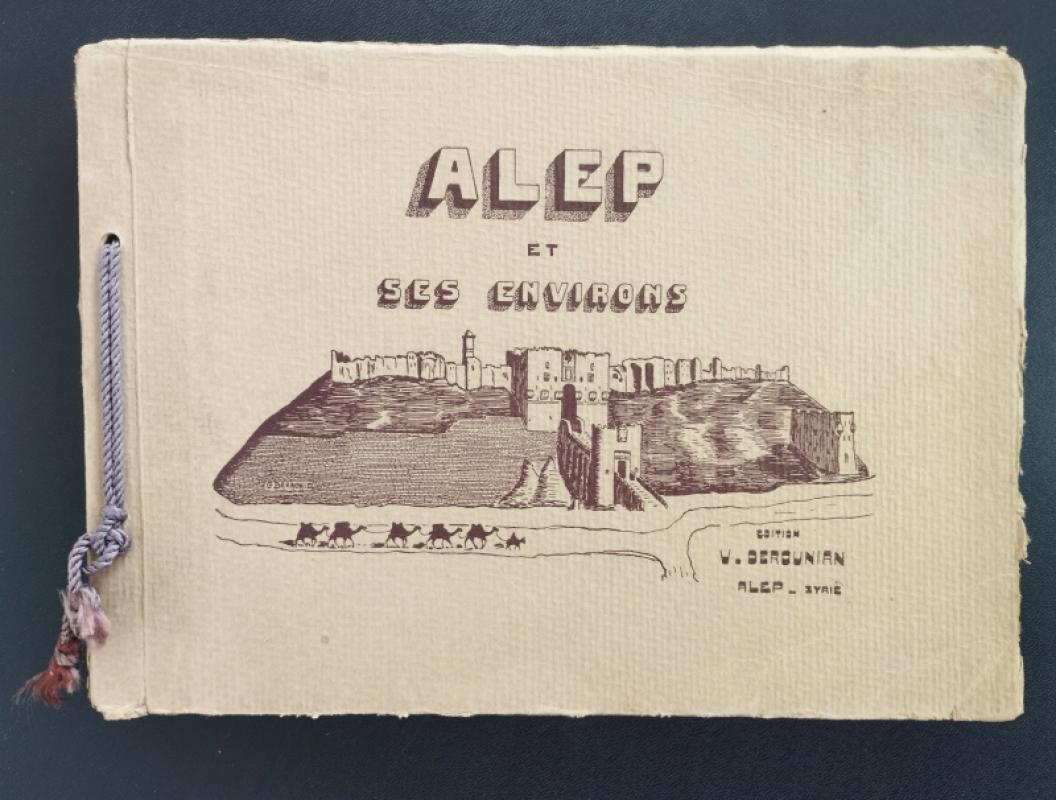
Alep et ses environs
DEROUNIAN (Vartan)
Édition V. Derounian
£375.00
Offered by Peffers Rare Books Ltd.
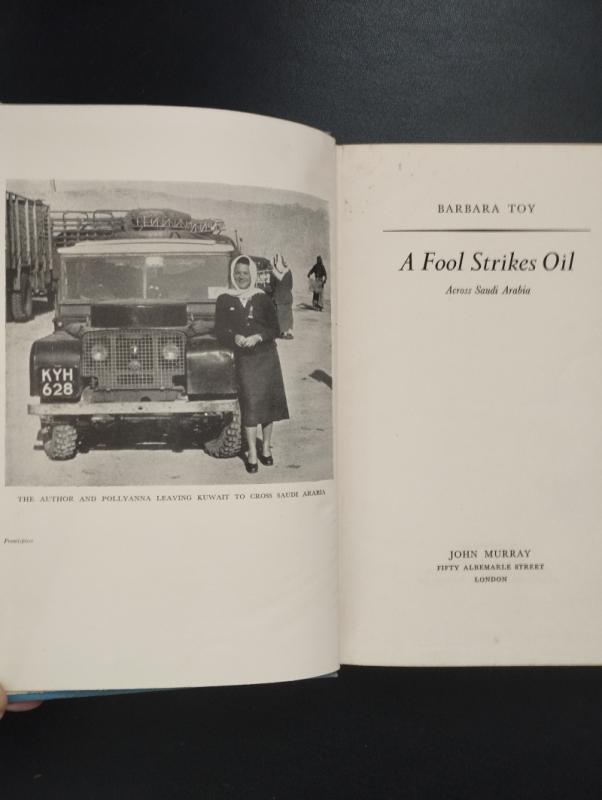
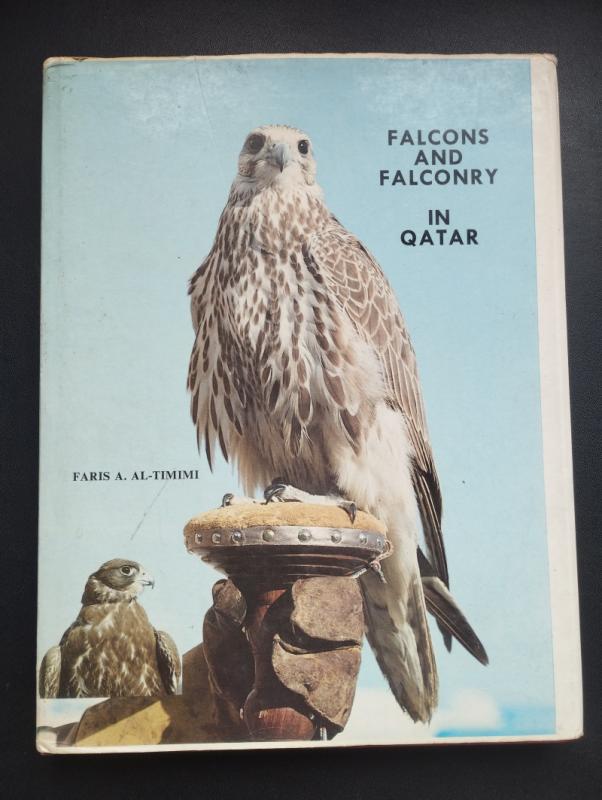
Falcons and Falconry in Qatar
AL-TIMIMI (Faris A.)
Doha, Privately published: Ali Bin Ali Printing Press.
£125.00
Offered by Peffers Rare Books Ltd.
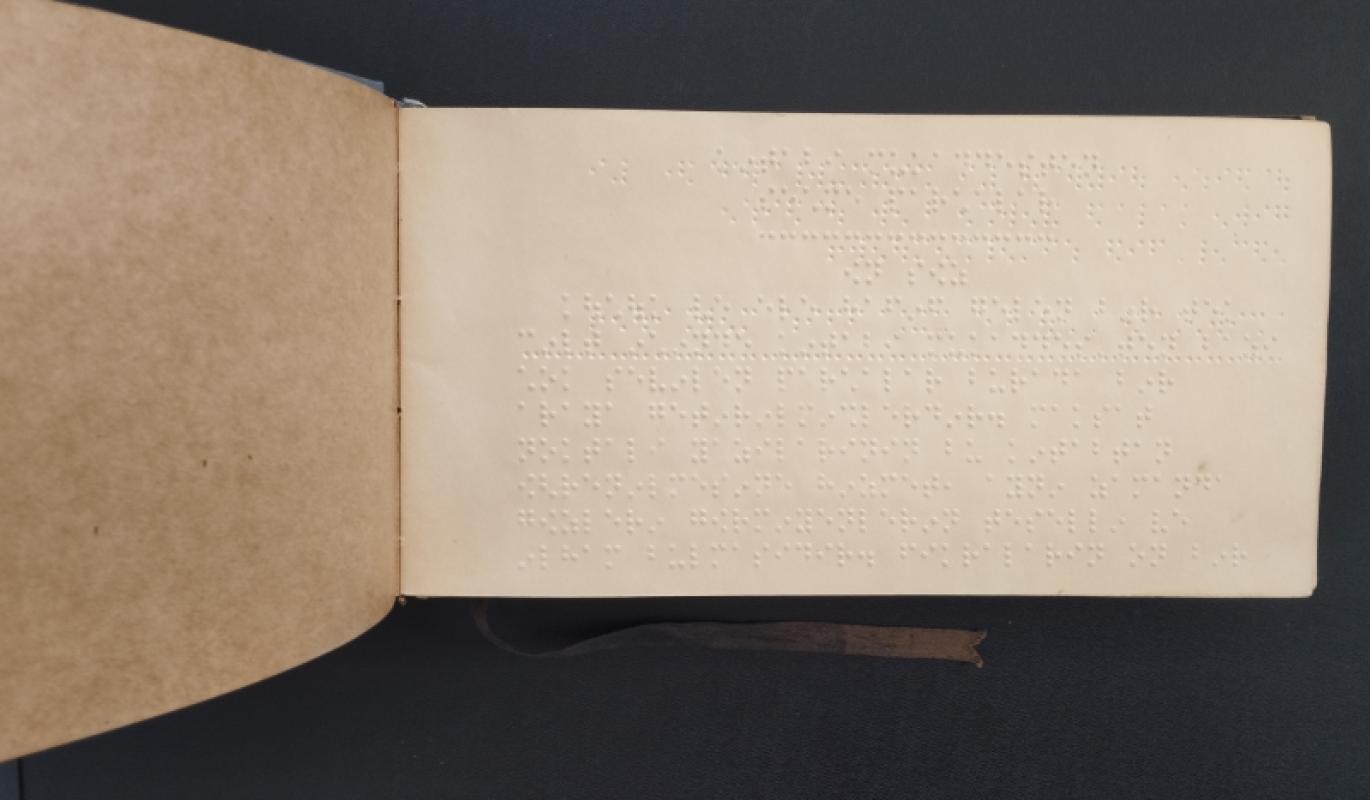
Kitabı Mukaddesten seçme parçalar Türkçe Breyl yaz...
BIBLE SOCIETY
Istanbul: [Bible Society in New York], p.r. Kitabi Mukaddes Sirketi 489 Istikial Caddesi
£300.00
Offered by Peffers Rare Books Ltd.
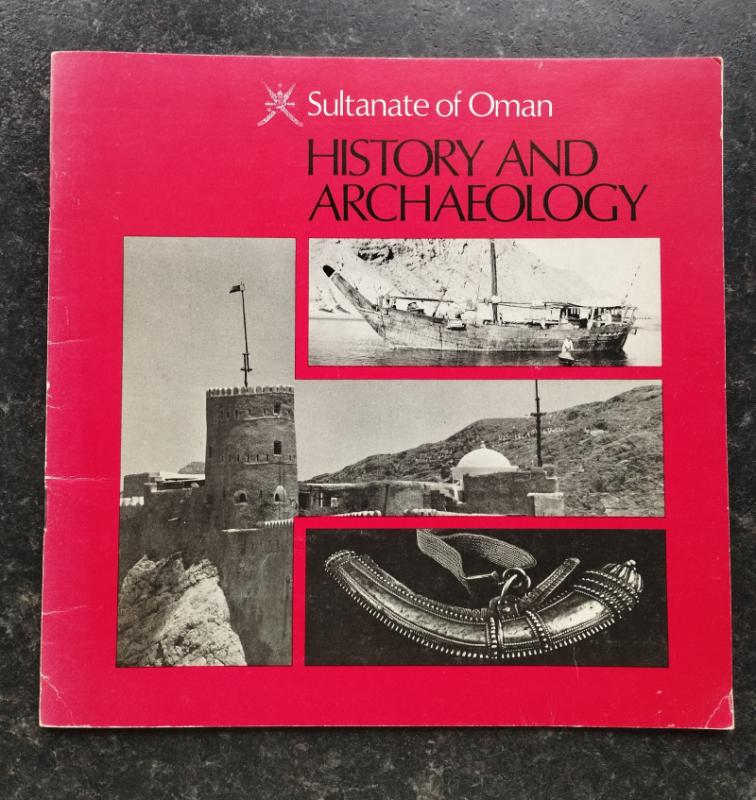
Sultanate of Oman History and Archaeology.
[OMAN]
Ministry of Information and Tourism, Sultanate of Oman
£50.00
Offered by Peffers Rare Books Ltd.
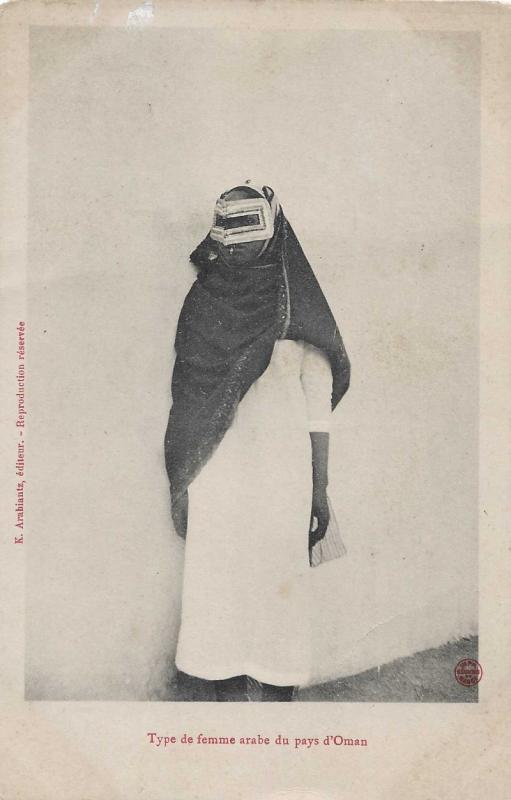
Type de femme arabe du pays d’Oman
ARABIANTZ (K. ed.)
ARABIANTZ (K. ed.)
£85.00
Offered by Peffers Rare Books Ltd.
Friends of the PBFA
Please email info@pbfa.org for more information