The Tale of the Emperor Coustans and of Over Sea
Book Description
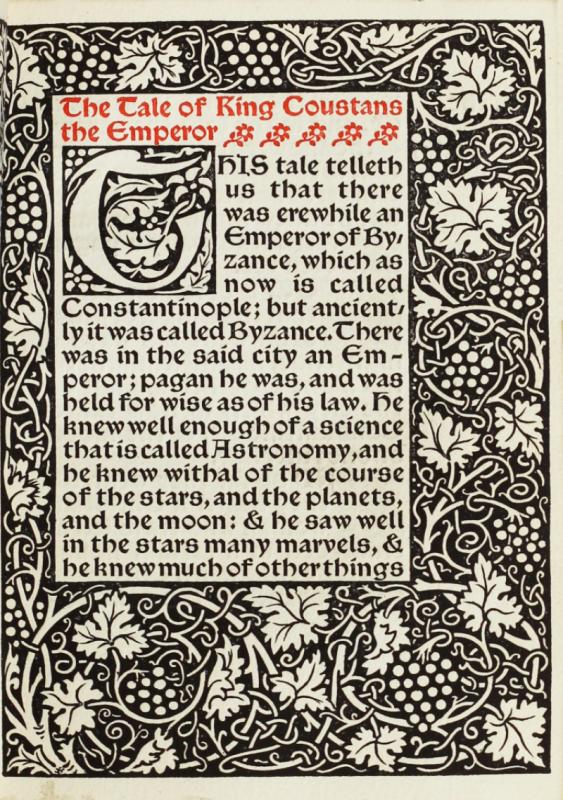
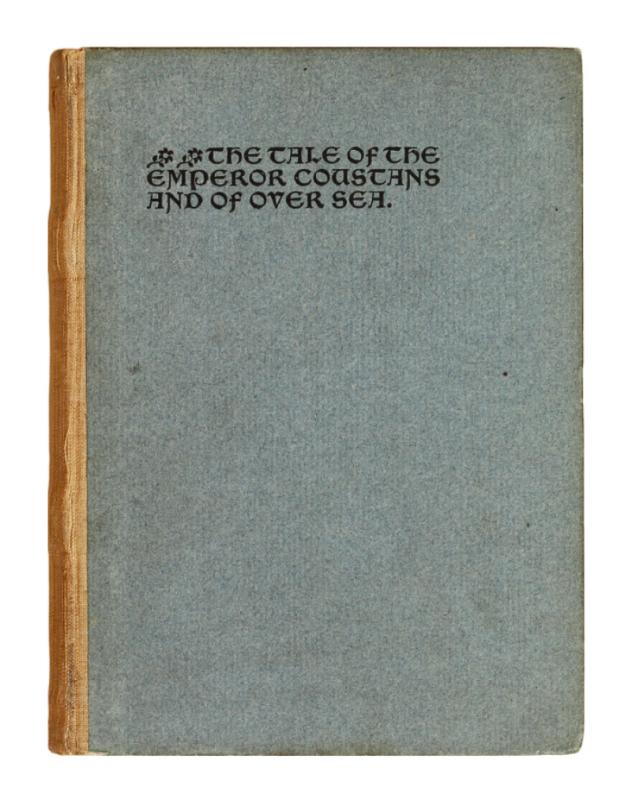
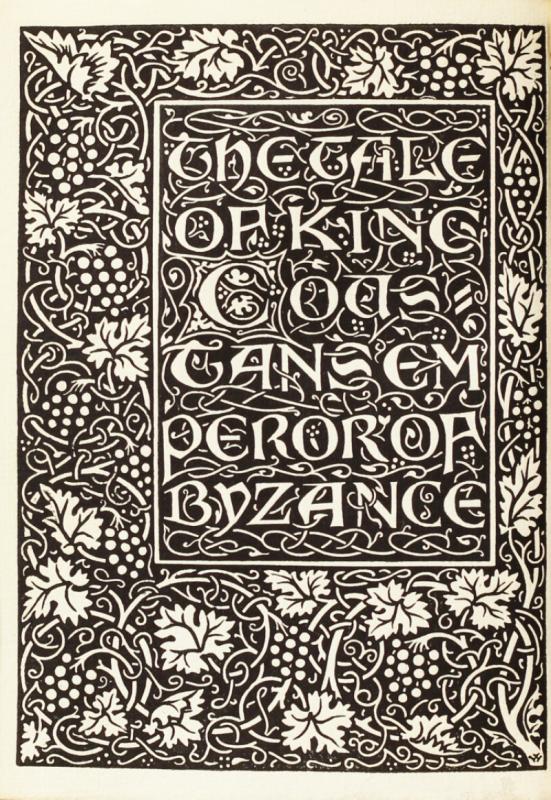
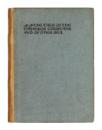
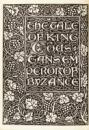
Sextodecimo in 8s (142 x 105mm), pp. [4 (blank ll.)], [4 (general title, verso blank, blank, wood-engraved part-title to ‘Emperor Coustans’)], [1]-38 (‘Emperor Coustans’), [39-40 (letterpress part-title and wood-engraved part-title to ‘Over Sea’)], [41]-130 (‘Over Sea’ and colophon), [6 (blank ll.)]. Printed in Chaucer type in red and black. 4 full wood-engraved borders and three- and six-line wood-engraved initials, all after Morris. (Very faint light marking at lower margin of some ll.) Original holland-backed boards [by J. & J. Leighton], upper board titled in black and with two flower ornaments. (Very light marking on boards, extremities slightly rubbed and bumped, short splits on spine.) A very good, crisp copy in the original binding. Provenance: Henry Sotheran Ltd, London (late-20th-/early-21st-century bookseller’s ticket on upper pastedown). ¶¶¶
Dealer Notes
The Tale of King Florus and the Fair Jehane, the first of these Kelmscott Press translations, was printed in an edition of 350 paper copies, and was evidently well received, since the print run was increased to 500 paper copies for Of the Friendship of Amis and Amile and remained at a similar level for The Tale of the Emperor Coustans and of Over Sea, the last of the three volumes in the series. The most substantial of the three volumes, The Tale of the Emperor Coustans and of Over Sea contains two stories, each with its own wood-engraved part-title giving the fuller titles ‘The Tale of King Coustans Emperor of Byzance’ and ‘A Tale of Over Sea’ (the latter also has a letterpress part-title). Interestingly, Sparling notes that ‘[f]rom the story of the Emperor Coustans grew that of “The Man born to be King”, one of the poems included in [Morris’s] The Earthly Paradise’ (The Kelmscott Press and William Morris Master-Craftsman, p. 108); similarly, Morris’s poem ‘Amys and Amillion’, intended for The Earthly Paradise but eventually omitted, had been based on the text he translated as Amis and Amile. ¶¶
The Tale of the Emperor Coustans and of Over Sea was completed on 30 August 1894, according to the colophon, and published on 26 September 1894 in an edition of 545 copies. 525 copies were printed on ‘Perch’ paper (as here) and priced at 7s. 6d., and 20 copies were printed on vellum and priced at 2 guineas. This copy was acquired by the previous owner from Henry Sotheran Ltd, the longest-established active antiquarian bookseller in England, which counted William Morris among its clients (cf. W.S. Peterson, Bibliography of the Kelmscott Press, p. 20). ¶¶
E. Le Mire, Bibliography of William Morris, A-73.01; W.S. Peterson, The Kelmscott Press (1985), A26. ¶¶¶
Please do not hesitate to contact us with any enquiries. This book is available directly from our website: www.TypeAndForme.com.
Other books
If you liked the book you've just seen, you might be interested in other books from the same dealer below.
Matrix. A Review for Printers & Bibliophiles. Issu...
RANDLE, John and Rosalind (editors)
Andoversford: The Whittington Press
£150.00
Offered by Type & Forme
‘On the Bearing of the Study of the Bántu Language...
KOLBE, Friedrich Wilhelm.
[London: Royal Asiatic Society].
£30.00
Offered by Type & Forme
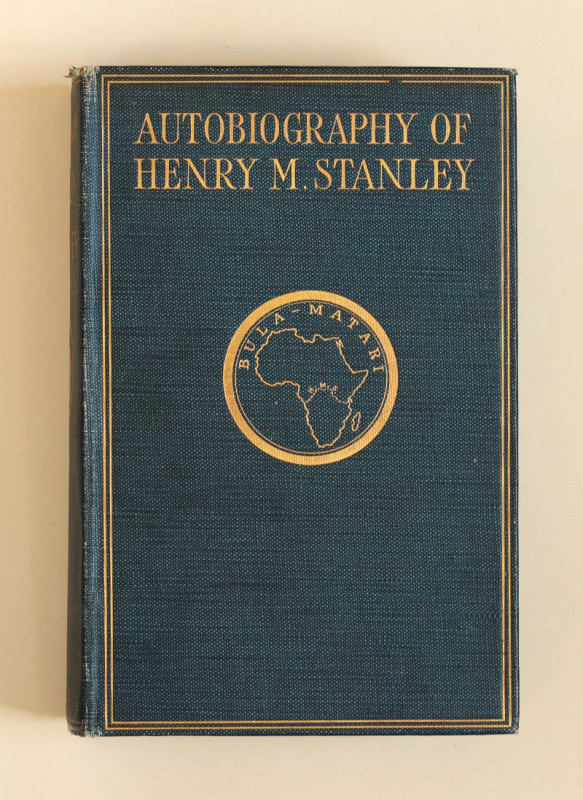
The Autobiography of Sir Henry Morton Stanley ......
STANLEY, Sir Henry Morton
London: ‘reprinted from American plates by William Clowes and Sons, Limited’ for Sampson, Low, Marston and Co., Ltd.
£49.50
Offered by Type & Forme
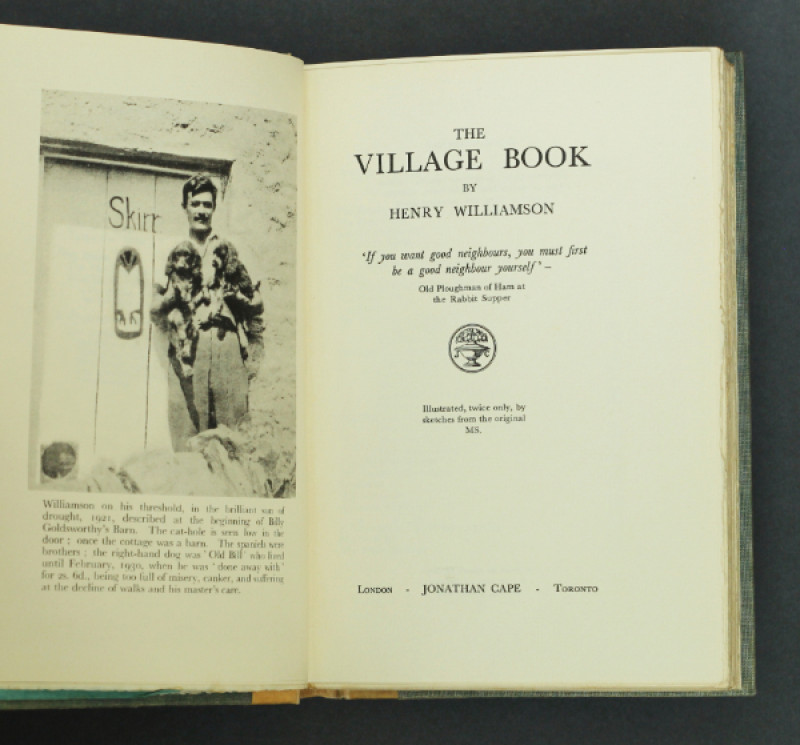
The Village Book ... Illustrated, Twice Only, by S...
WILLIAMSON, Henry William
London and Toronto: The Alden Press for Jonathan Cape
£95.00
Offered by Type & Forme
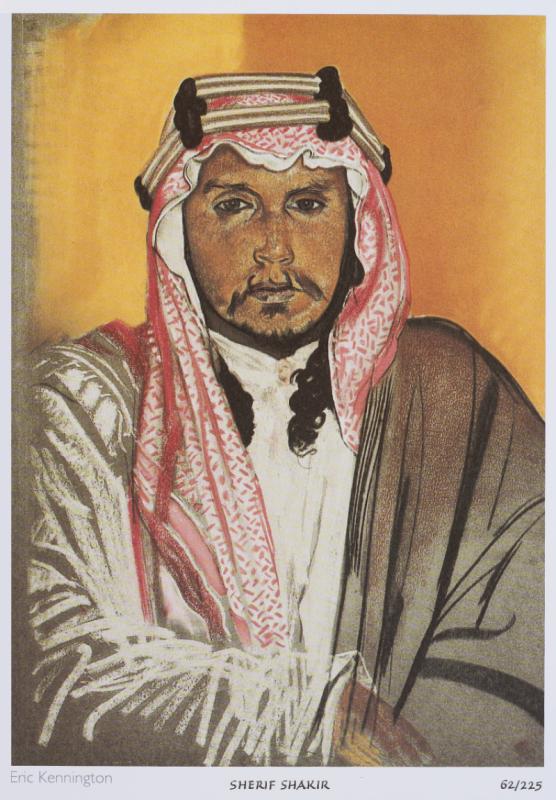
‘Sherif Shakir’ [portrait for Seven Pillars of Wis...
KENNINGTON, Eric Henri
Fordingbridge: Castle Hill Press
£95.00
Offered by Type & Forme
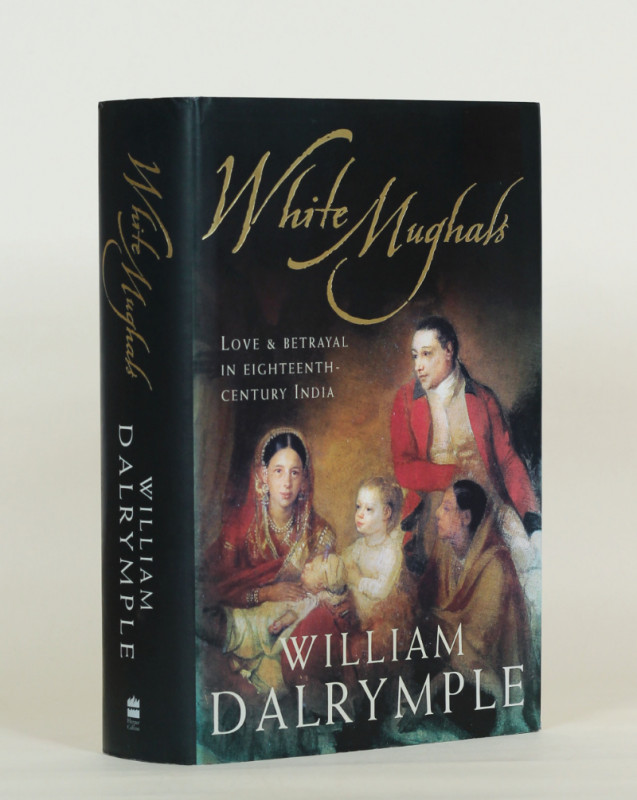
White Mughals. Love and Betrayal in Eighteenth-Cen...
DALRYMPLE, William
London: Clays Ltd, St Ives plc for HarperCollinsPublishers
£35.00
Offered by Type & Forme
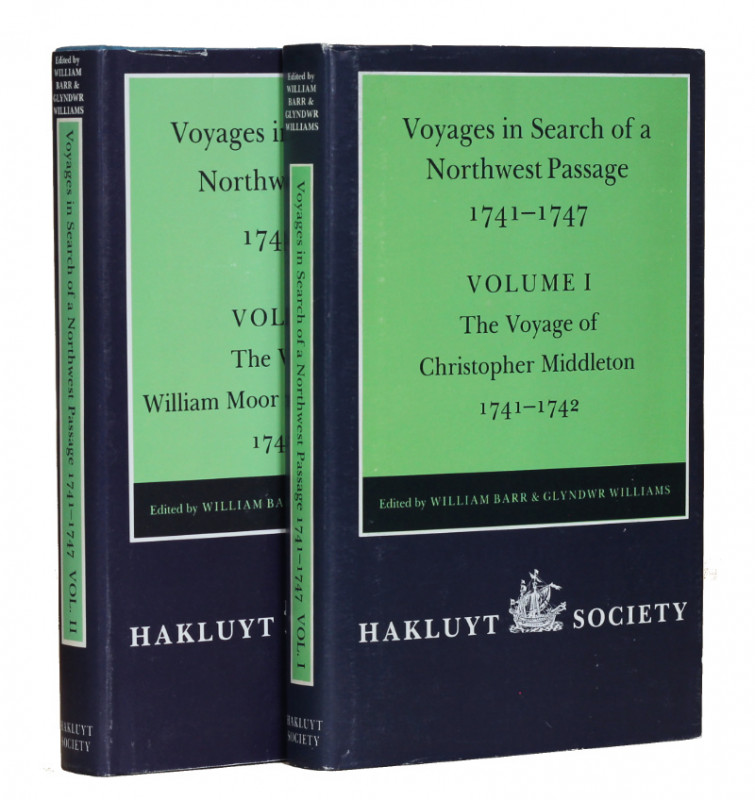
Voyages to Hudson Bay in Search of a Northwest Pas...
BARR, William and Glyndwr WILLIAMS (editors)
London: The University Press, Cambridge for The Hakluyt Society
£49.50
Offered by Type & Forme
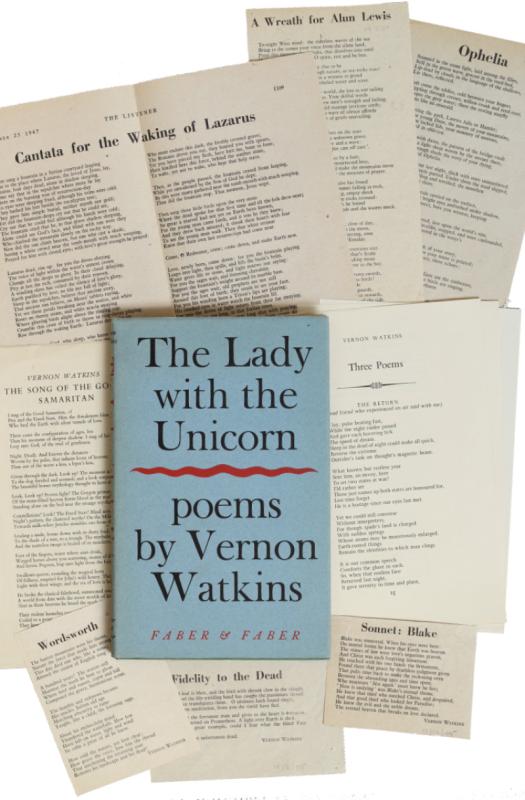
The Lady with the Unicorn
WATKINS, Vernon Phillips
London: The Bowring Press for Faber and Faber
£37.50
Offered by Type & Forme
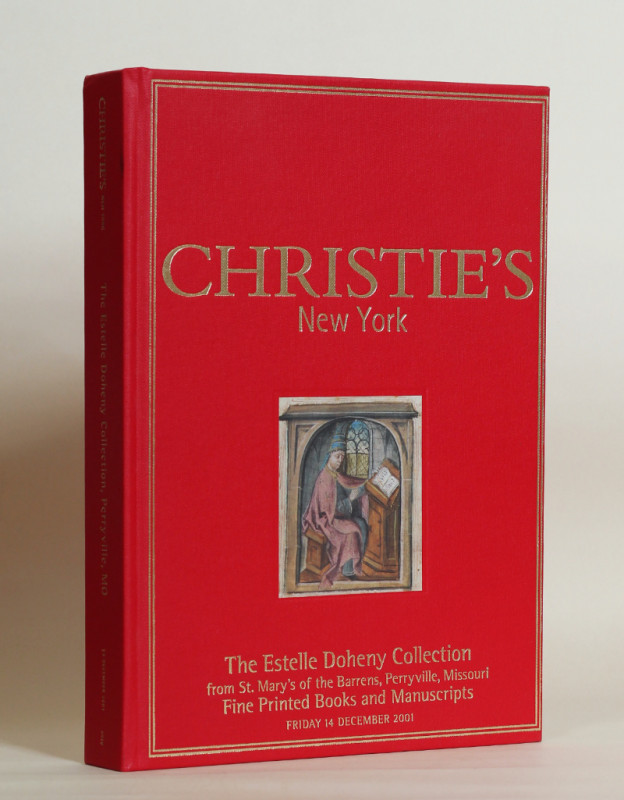
The Estelle Doheny Collection from St. Mary’s of t...
DOHENY, Carrie Estelle Betzold – CHRISTIE’S
New York: Christie’s International Media Division for Christie’s
£29.50
Offered by Type & Forme
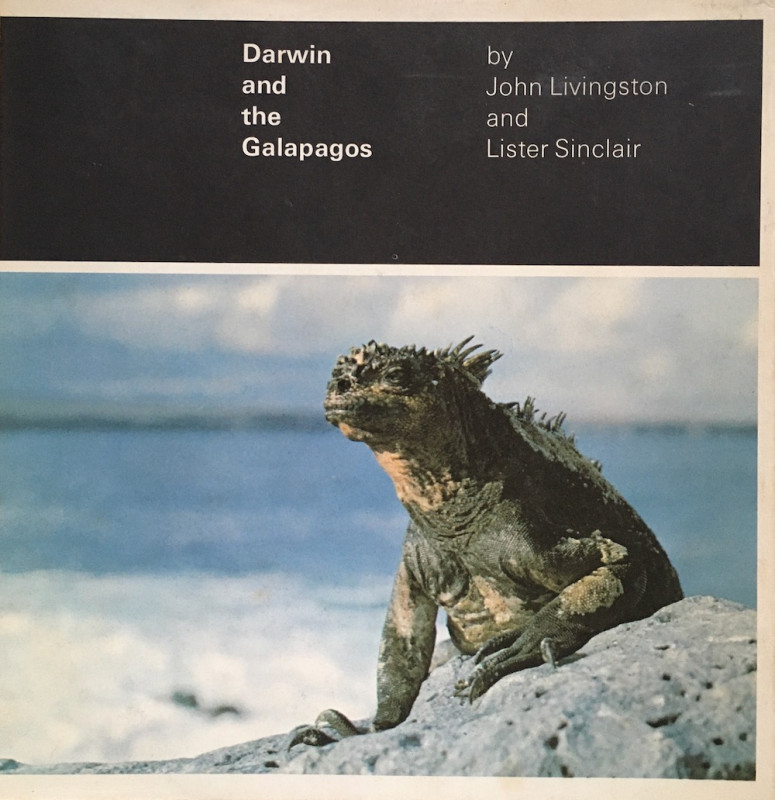
Darwin and the Galapagos
LIVINGSTON, John and Lister SINCLAIR
Toronto: Canadian Broadcasting Corporation
£14.95
Offered by Type & Forme
Friends of the PBFA
Please email info@pbfa.org for more information