Book Description
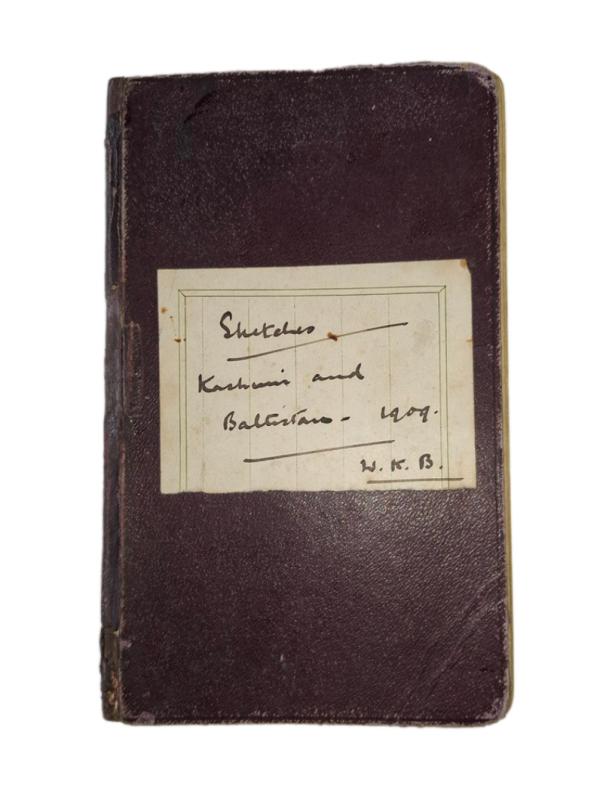
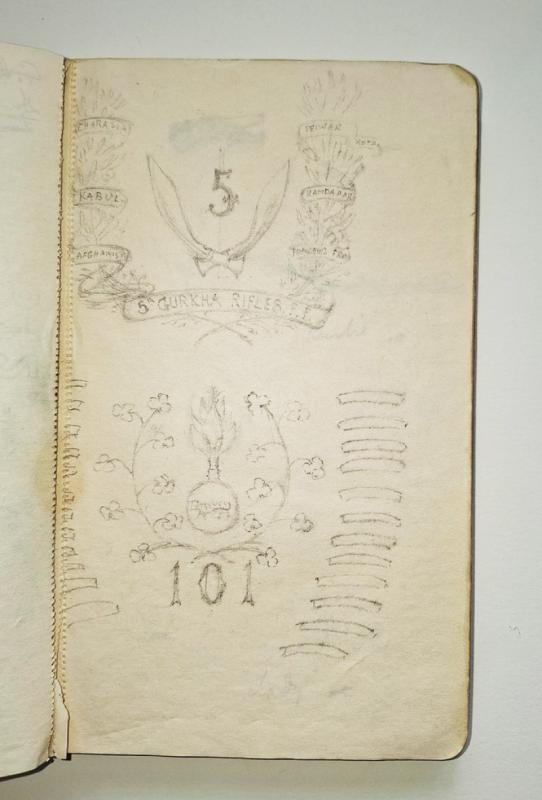
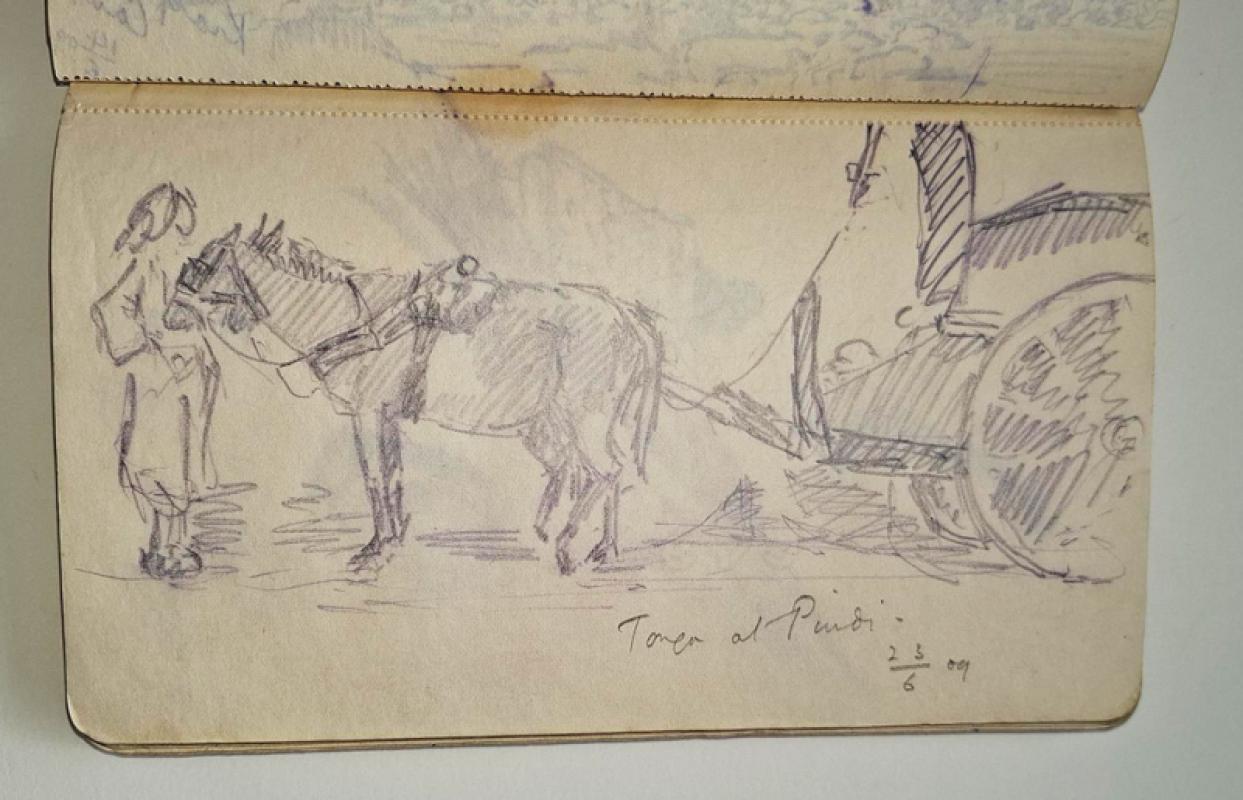
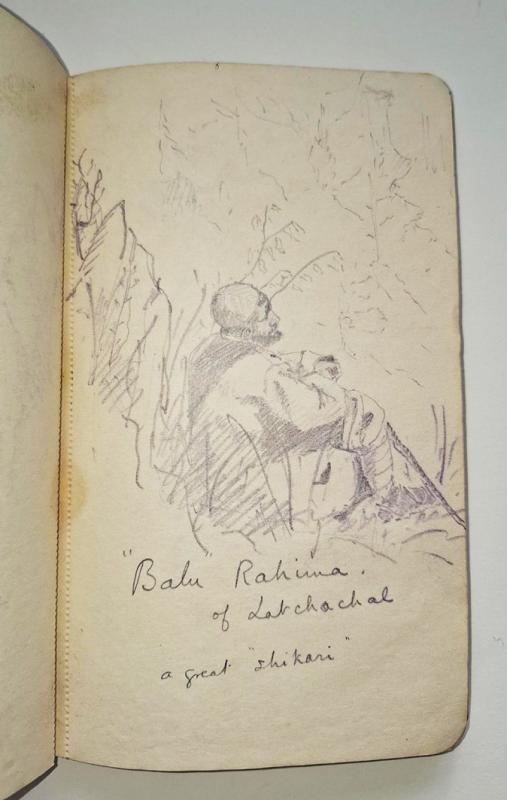
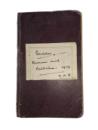
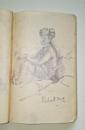
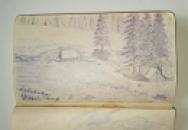
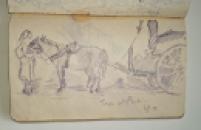
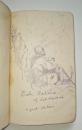
This is an original sketchbook, belonging to Wynyard Keith Brown, an officer in the 5th Gurkha Rifles while he was stationed in Kashmir and Balistan in 1909. It is a small pocket book with handwritten label to front ("Sketches, Kashmir and Balistan, 1909, WKB"), and measures 18.5 × 10.5cm, the pages perforated to the inner margin. There are 57 pencil sketches, and one loose by another hand, with a few blank pages.
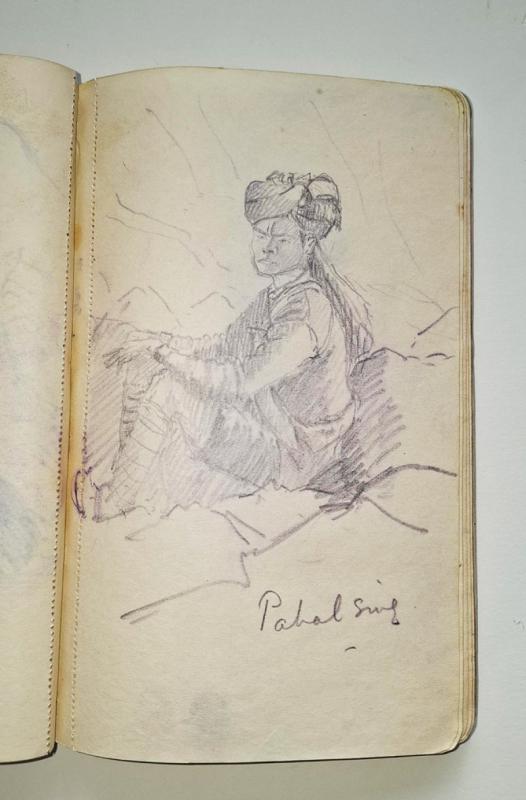
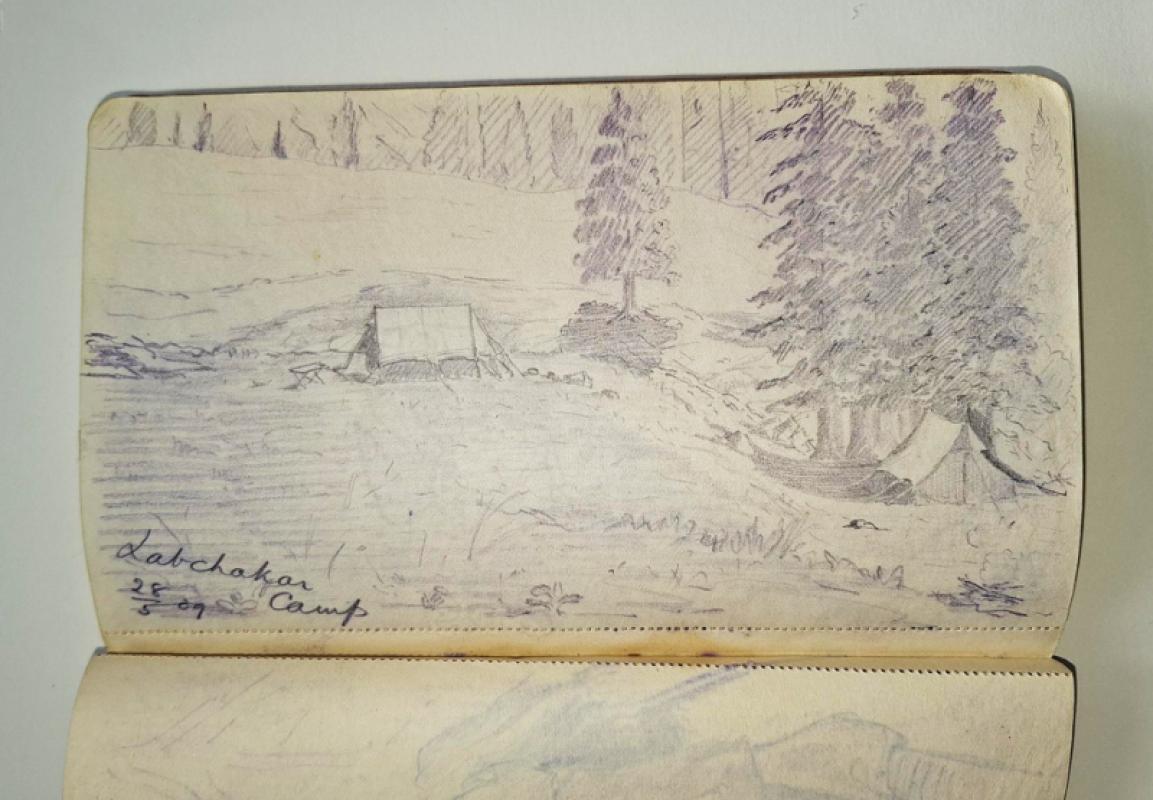
The sketches are mostly the people he worked with (or worked for him), and in his language, they are titled as Fatteh Alma; an orderly, The Shikar (Guffara); the Tiffin Coolie; A Coolie (Kralpora); Pitamber wearing a puggra (?) after his go in the sun; a very poor attempt at the Dak coolie; Fergusson and "Stuffy" (a fellow officer in pith helmet and monkey); shikari Shabana; "Salaam Salut, my Hindoo bearer 'Dukki' elcoming me back; etc etc, as well as sketches of pets and local animals, and views (these are drawn in landscape format) such as "Labchakan Camp", a glimpse of the Wooler (Wular) Lake; Kralpora Camp; Camp Atwattoo (Athwatoo); Deasoi Plain; Fourth Bridge, Srinagar. Most of the sketches are quite detailed, if amateur, and a few are preliminary or unfinished. They form an interesting record of a soldier's life or travel and hunting in Northern India and regions in the years before the Great War.
The artist, Wynyard Keith Brown, was born in Lucknow in 1888, the son of Colonel Francis David Millet Brown VC, his Victoria Cross was awarded during the Indian Mutiny of 1857, and was educated at Wellington College. He commissioned into the Indian Army and posted to the 5th Ghurka Rifles in 1907. He served in Egypt at the start of the Great War, before being deployed to Gallipoli attached to the 9th Battalion West Yorkshire Regiment (Prince of Wales's Own). He was killed in action on 4 June 1915 leading a company to recover trenches lost by the 6th Gurkhas. He was mentioned twice in despatches.
Captain Wynyard Keith Brown 1/5th Gurkha Rifles (Frontier Force) and killed in action on 4 June 1915 at the Dardenelles, Turkey. “In early June the 1/5th 2/10th Gurkhas arrived, but they soon discovered the difficulties, if not the impossibilities, of attacking an enemy lodged in well-hidden nests while the only protection to troops below was in the shadow of overhanging rocks…. Within a few hours the 1/5th lost 129 men and 7 British officers.” [“The Gurkhas” John Parker, London 1999, p118] He was awarded Victory and British medals and 1915 Star, issued by the Government of India. In the 1 January 1912 Indian Army quarterly lists he appears twice as Brown, W.K.: with 1/5th Gurkha Rifles (Frontier Force), a “Double co. Officers-With 2/6th GR”, 1st commissioned 24 January 1906, rank Lieutenant from 24 April 1908 (on page 439). On 441 he is listed as commissioned 4 January 1906 and with 6th Gurka [sic] Rifles and Attached--1--5th G.R. for Chitral Rebels. Chitral, annexed in 1895, is high in the Hindu Kush, where Russia, China and Afghanistan contested no man’s land and had been a region of unrest since the 1870s since when Britain had kept the commercially important 140 mile road from Peshawar ro Chitral open, as well as the 600 mile road to Kashmir. He was the son of Colonel Francis David Millett Brown VC, born in Kasuli Punjab in 1880, according to his will probate on 21 January 1918 and on active duty with the 4th Gurkhas [sic]. Administration to widow Mabel Louisa Brown, effects £503 2s 9d. Further research reveals that he was born on 28 October 1887 in Lucknow, Bengal, India, although he did live at Kasuli, Punjab. His mother was Jessie Doris. His widow Mabel Louisa Brown emigrated to South Africa in 1925. His mother Jessie Doris Brown and sister Jessie Vera Lawford Brown were boarders with Yatelely carpenter James Bunch in 1911. He was an uncle of Bert Bunch (also a casualty of WW1). On 5 September 1914 he married Mabel Louisa Seymour (1873-27 March 1951). daughter of General Lord William Frederick Ernest Seymour (1838-1915) and Hon. Eva Anna Caroline Douglas-Pennant (1853-1934). Mabel Brown died at Chapel House Nursing Home Speldhurst, Tumbridge Wells, Kent. Her effects were £10727 13s 11d. Their only son, Francis David Wynyard Brown, born between October and December 1915 in Kensington, London, was a member of HM Diplomatic Service (Gazetted on 24 September 1938 as a Third Secretary, he was Assistant Private Secretary to Winston Churchill in 1941, and honoured on 13 June 1959 as Third Class of the Distinguished Order of St Michael & St George). Interestingly enough, he accompanied Churchill on 6 January 1942 on the first Transatlantic flight by a head of state, in a BOAC Boeing 314 which had a range of 3600 miles for a trip of 3300 miles, with no fighter escort and within range of the Luftwaffe for the last 2 or 3 hours of the flight. Unfortunately, the navigator forgot to allow for wind and they were 100 miles off course, and only 90 miles from Brest. The Luftwaffe scrambled and Captain Kelly steered north. Then the radar at Devonport caught them and scrambled fighters thinking it was a German bomber! Fortunately the fighters from either side missed them and Kelly landed at Mountbatten flying boat base at 10am after a 17 hours 55 minutes flight. Captain Wynyard Keith Brown is buried at Gallipoli, Canakkale, Turkey.