The Golden Legend of Master William Caxton Done Anew. [Edited by Frederick Startridge Ellis]
Book Description
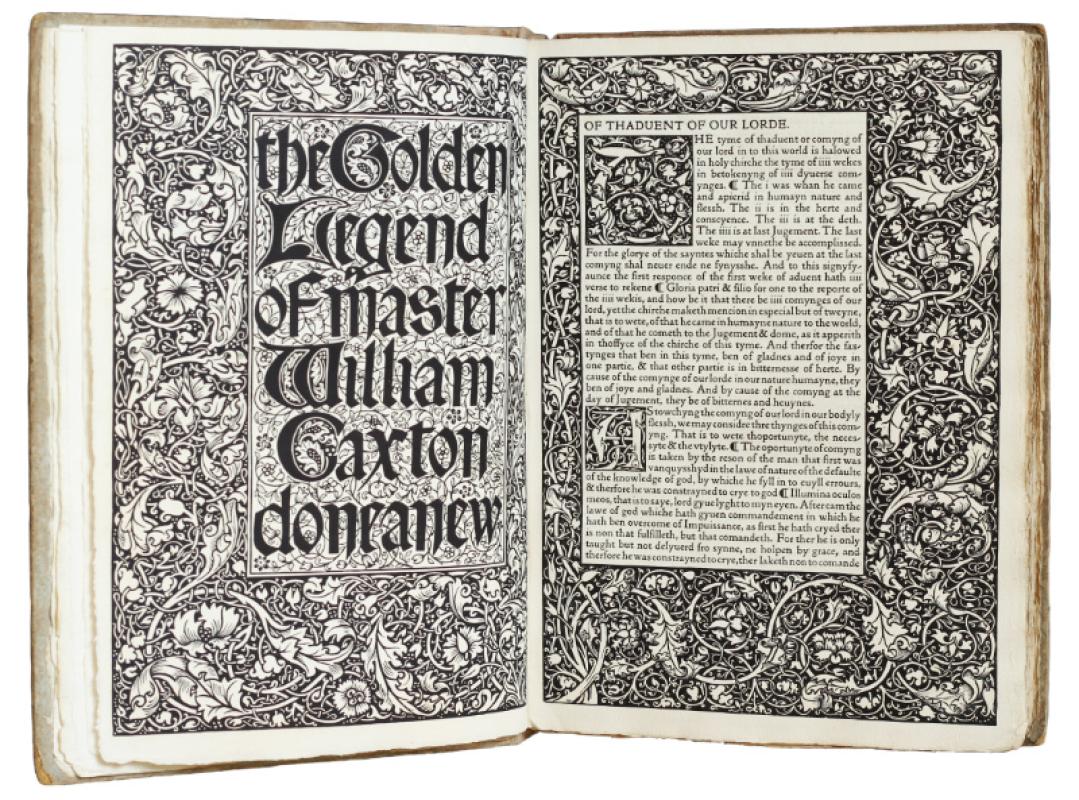
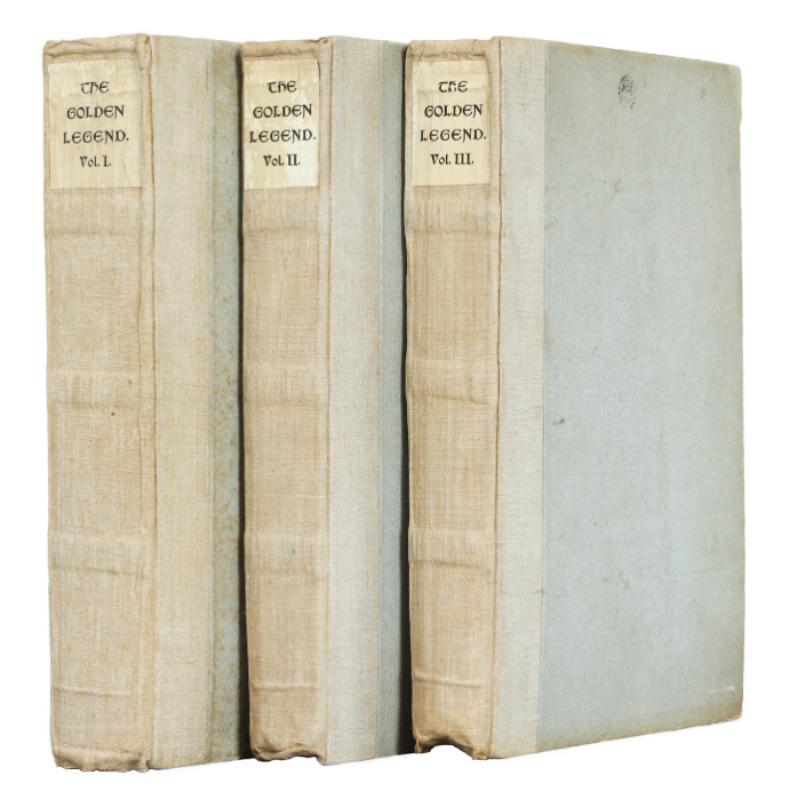
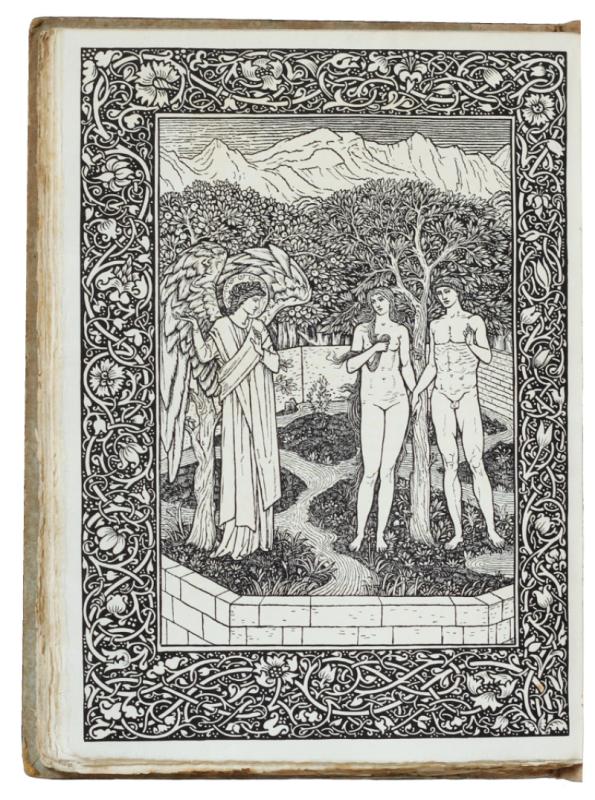
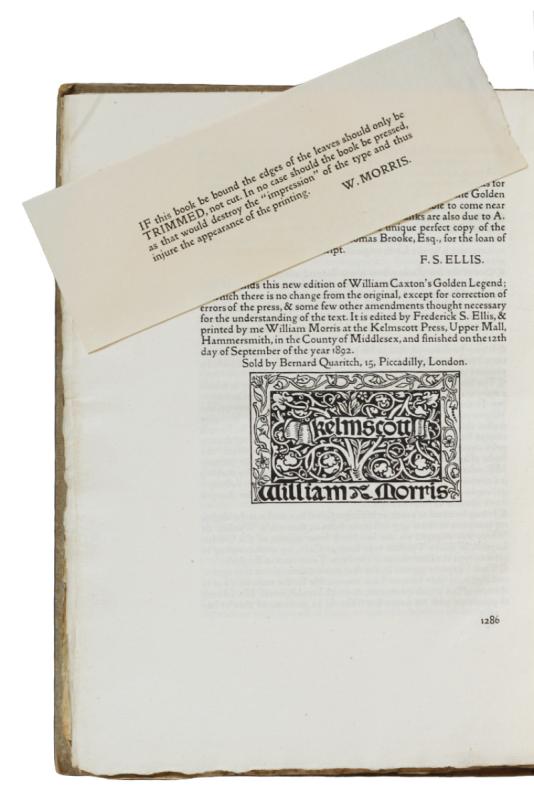
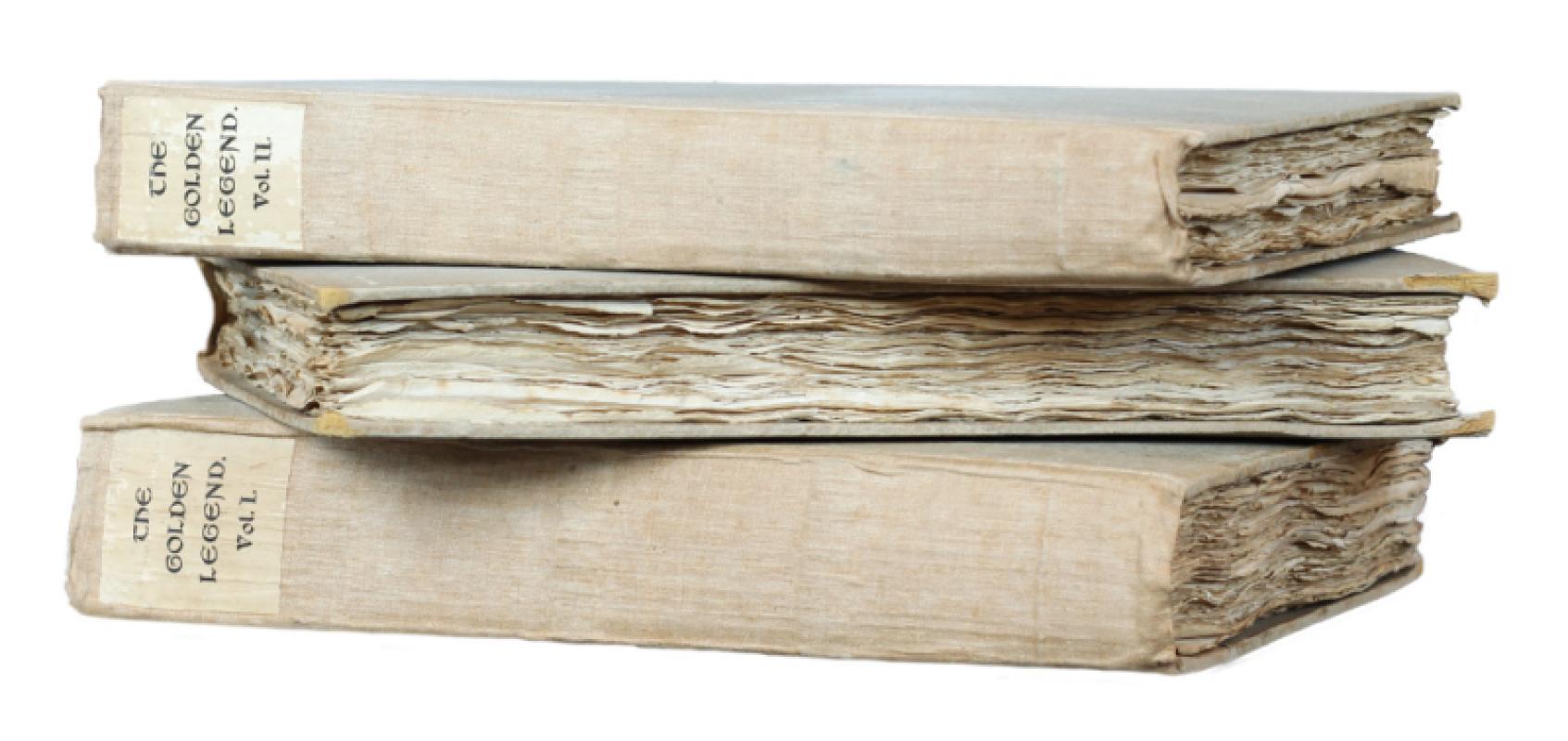
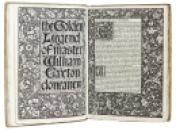
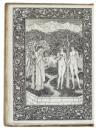
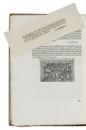
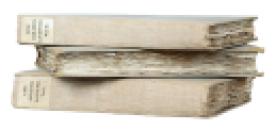
3 volumes, quarto in 8s (293 x 205mm), pp. I: [i]-xii (half title, verso blank, contents), [2 (blank, full-page wood-engraved title)], [1]-103, [104 (blank)], [2 (blank l.)], [2 (blank, full-page wood-engraving)], [105]-244, [2 (blank, full-page wood-engraving)], [245]-464; II: [2 (blank, part-title)], 465-864; III: [2 (part-title, verso blank)], 865-1281, 1282-1286 (‘Memoranda, bibliographical & explanatory’, colophon); [2 (blank l.)]. Printed in Golden type. Wood-engraved title with border by W.H. Hooper after Morris and 2 full-page wood-engraved illustrations by Hooper after Edward Burne-Jones. Wood-engraved initials and borders by Hooper and George Campfield after Morris throughout, and wood-engraved press-device after Morris [Peterson printer’s mark no. 1]. Loosely-inserted letterpress slip ‘IF this book be bound…’ printed in Golden type. (Occasional faint spotting and light offsetting, a few light marks, deckles slightly dusty and spotted.) Original holland-backed, light blue boards [by J. and J. Leighton], spines with applied letterpress title-labels printed in Troy type, uncut and retaining deckles. (Light offsetting on endpapers, some spotting and marking, extremities slightly rubbed and bumped.) A very good, uncut set, retaining the letterpress slip. Provenance: [?]Thomas Thorp, Guildford (pencilled note on rear free endpaper of vol. I giving details of title and wood-engravings with name ‘Thorp, Guildford’) – Bernard Quaritch Limited, London (‘A List for Autumn. List 2014/4’, no. 35). ¶¶¶
Dealer Notes
The Golden Legend was assembled by Jacobus de Voragine in the second half of the thirteenth century, and this important medieval hagiology held a strong appeal for William Morris (at his death Morris owned at least ten early editions of the work). Although numerous texts by Caxton had been reprinted by the Early English Text Society in the 1870s and 1880s, the only nineteenth-century reprinting of The Golden Legend was an incomplete edition by the Holbein Society which appeared in 1878. F.S. Ellis, the editor of this edition, explained the significance of the work in his explanatory notes at the end of the third volume: ‘Among the books which serve to illustrate the religious life and mode of thought that prevailed in the middle ages, none holds a more important place than the “Legenda Aurea”’ (p. 1282). Ellis’s daughter, Phillis, undertook the immense task of transcribing the text from Caxton’s 1483 first edition, borrowed from Cambridge University Library. ¶¶
The two full-page wood-engravings in this edition were Edward Burne-Jones’s first illustrations for the Kelmscott Press – illustrations which characterised so much of the press’s output and culminated in Burne-Jones’s 87 illustrations for the Kelmscott Chaucer in 1896. The artist’s final contributions were two wood-engravings for the penultimate publication of the Kelmscott Press, Love is Enough, or the Freeing of Pharamond, issued in December 1897 – a few months before Burne-Jones’s death in June 1898. ¶¶
To publish The Golden Legend, Morris collaborated with the bookseller and publisher Bernard Quaritch, and the edition was originally intended to be 250 sets, although this was later doubled to 500 printed on ‘flower’ paper made by Joseph Batchelor and Son for the Kelmscott Press (the lack of suitable vellum meant that, despite a short-lived plan to approach the Pope for supplies, the work was only printed on paper). In a letter to Ellis dated 6 September 1890, prior to the establishment of the Kelmscott Press in January 1891, Quaritch agreed to bear the entire cost of producing the work, whilst giving Morris complete control over choice of paper and printer; in return, Morris and Ellis agreed to receive no remuneration other than twelve free copies each. ¶¶
The publication of the Kelmscott Golden Legend on 3 November 1892 was met with widespread acclaim, and it was reviewed favourably in The Times and The Library. Morris himself wrote to Quaritch that he was ‘proud of it, and of having pushed it through so promptly’ (Peterson, Bibliography, p. 23), and the poet A.C. Swinburne called it, ‘the most superbly beautiful book that ever, I should think, came from any press’ (W.S. Peterson, The Kelmscott Press (Berkeley, CA, 1991), p. 216). ¶¶
W.S. Peterson, Bibliography of the Kelmscott Press (1985), A7. ¶¶¶
Please do not hesitate to contact us with any enquiries. This book is available directly from our website: www.TypeAndForme.com.
Other books
If you liked the book you've just seen, you might be interested in other books from the same dealer below.
Bookbinding in the British Isles Sixteenth to Twen...
MAGGS BROTHERS LTD
London: B.A.S. Printers Limited for Maggs Bros Ltd
£79.50
Offered by Type & Forme
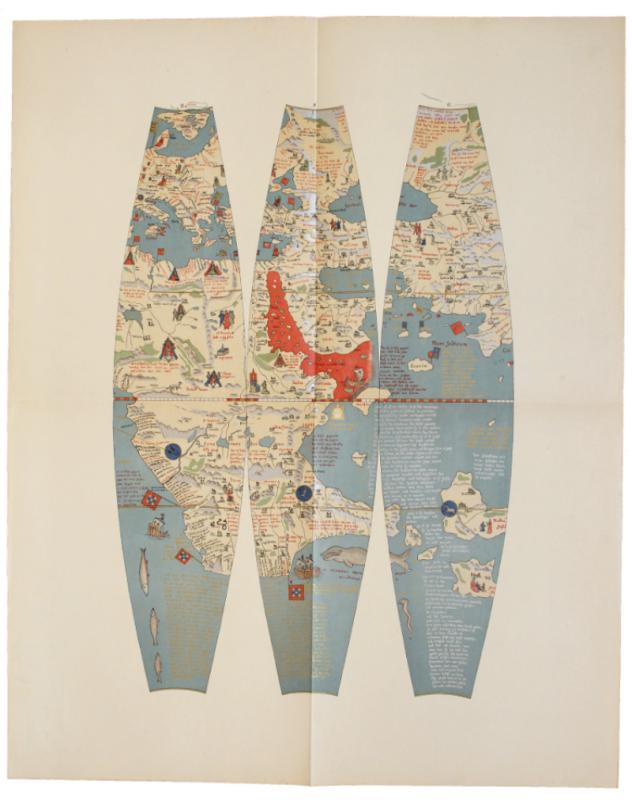
Martin Behaim. His Life and his Globe ... With a F...
RAVENSTEIN, Ernst Georg
London: George Philip & Son, Ltd.
£275.00
Offered by Type & Forme
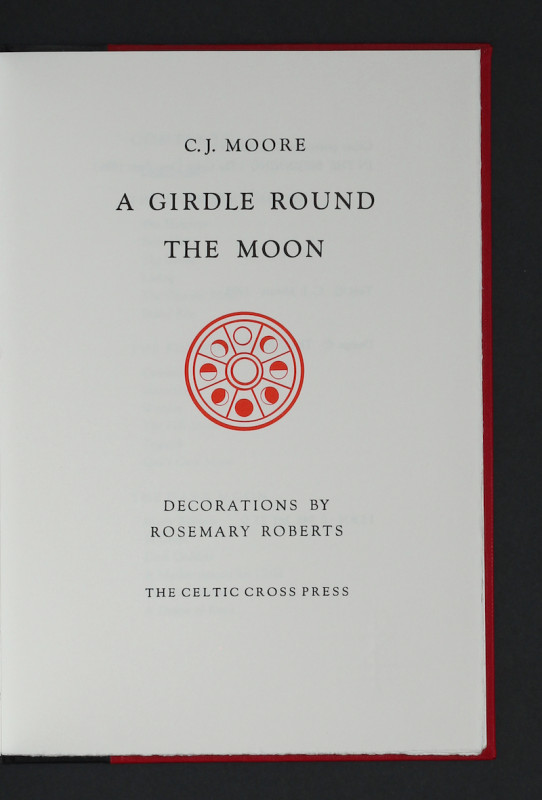
A Girdle Round the Moon [one of 125 copies signed...
MOORE, Christopher J. and Rosemary ROBERTS (artist)
Lastingham: The Celtic Cross Press
£39.50
Offered by Type & Forme
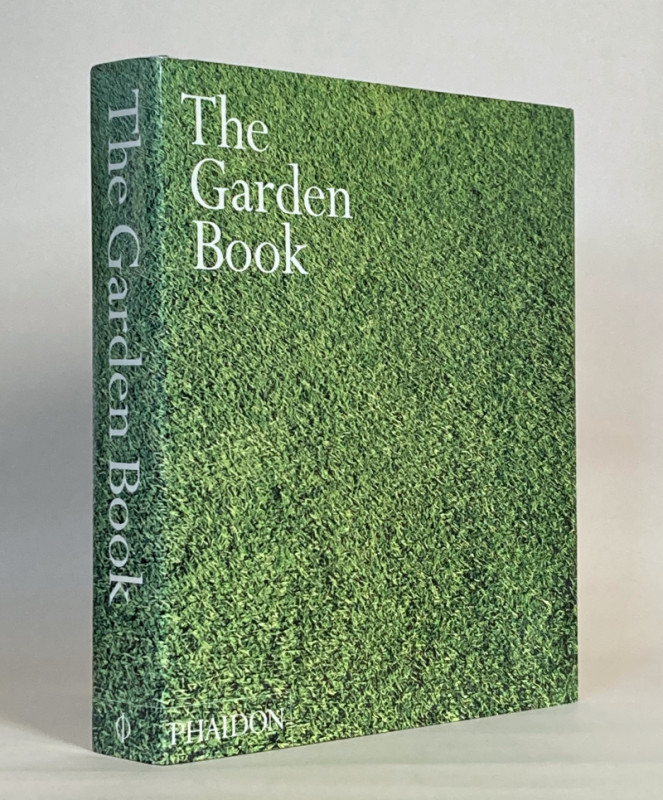
The Garden Book
RICHARDSON, Tim (editor)
London: Phaidon Press Limited
£29.50
Offered by Type & Forme
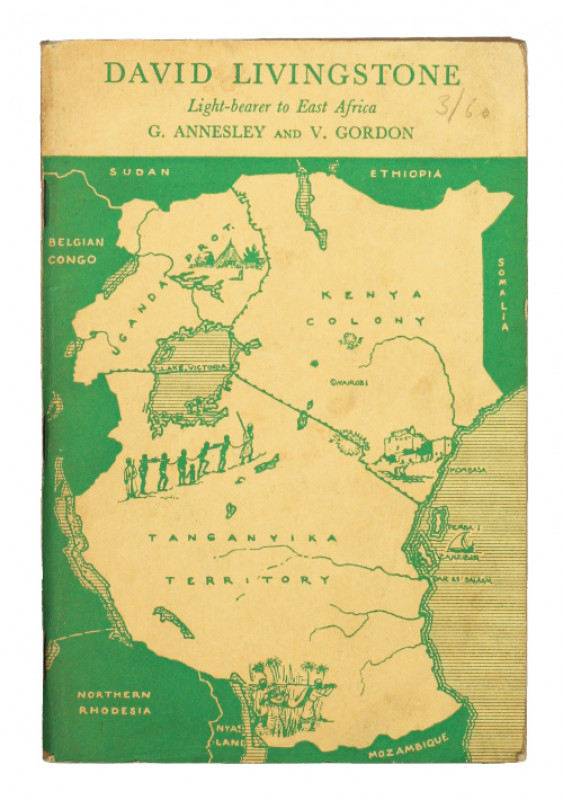
David Livingstone: Light-Bearer to Africa [from th...
ANNESLEY, George and Violet GORDON
London and New York: Richard Clay and Company, Ltd. for Macmillan & Co Ltd and St Martin’s Press
£39.50
Offered by Type & Forme
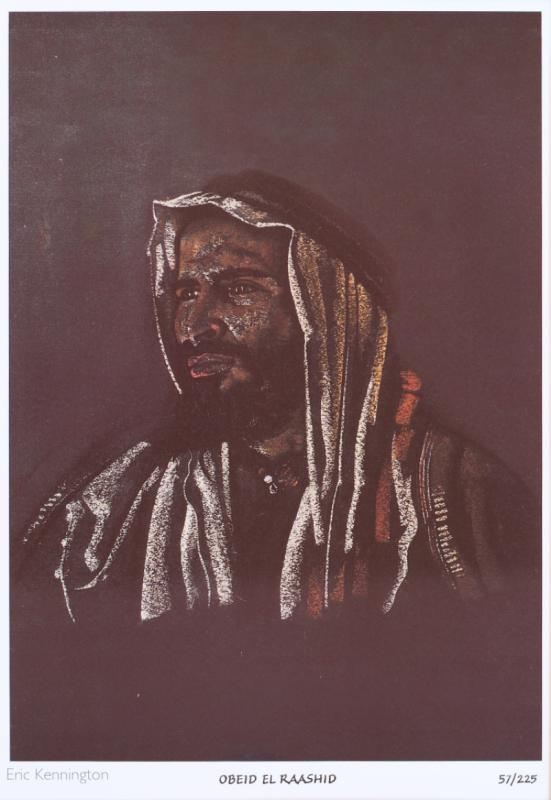
‘Obeid el Raashid’ [portrait for Seven Pillars of...
[T.E. Lawrence] -- KENNINGTON, Eric Henri
Fordingbridge: Castle Hill Press
£95.00
Offered by Type & Forme
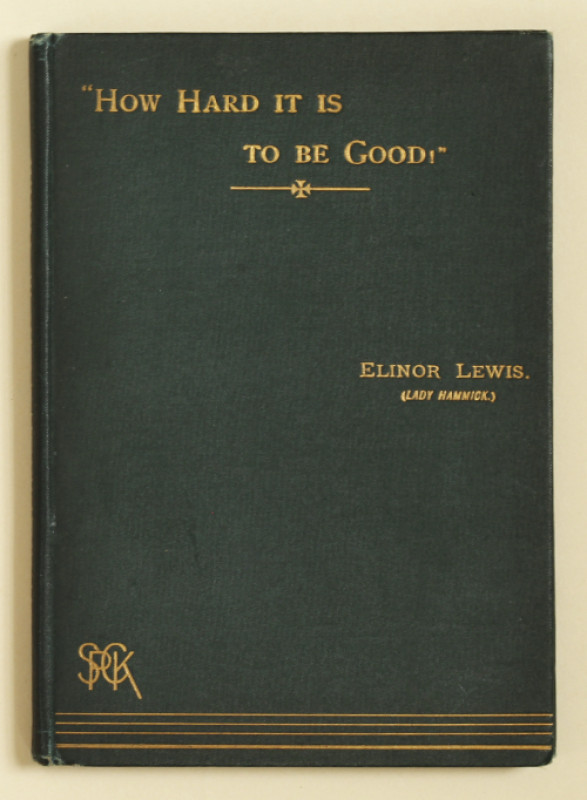
‘How Hard it is to be Good’ and Other Readings for...
LEWIS, Elinor [i.e. Lady Elinor HAMMICK]
London and New York: William Clowes and Sons, Limited, for Society for Promoting Christian Knowledge and E. & J.B. Young and Co.
£29.50
Offered by Type & Forme
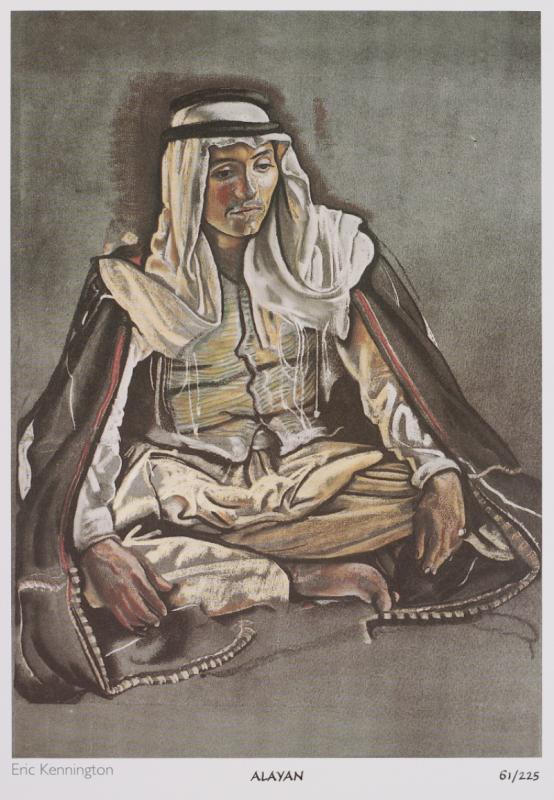
‘Alayan’ [portrait for Seven Pillars of Wisdom, li...
[T.E. Lawrence] -- KENNINGTON, Eric Henri
Fordingbridge: Castle Hill Press
£95.00
Offered by Type & Forme
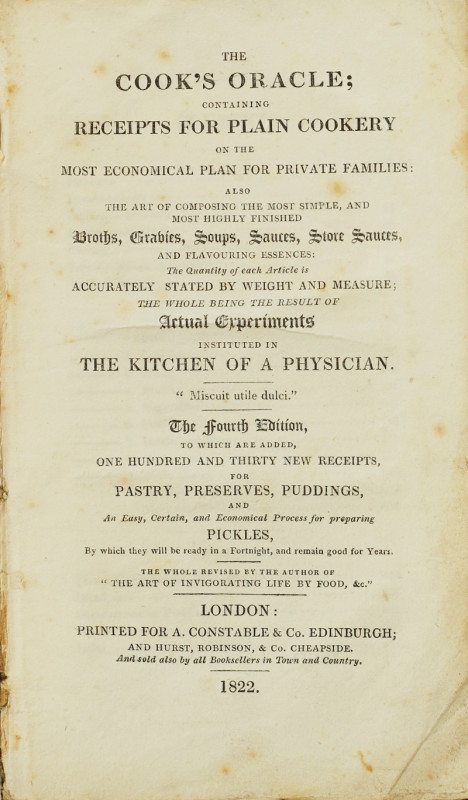
The Cook’s Oracle; Containing Receipts for Plain C...
[KITCHINER, William]
London: J. Moyes ‘for A. Constable & Co. Edinburgh; and Hurst, Robinson, & Co.’
£149.50
Offered by Type & Forme
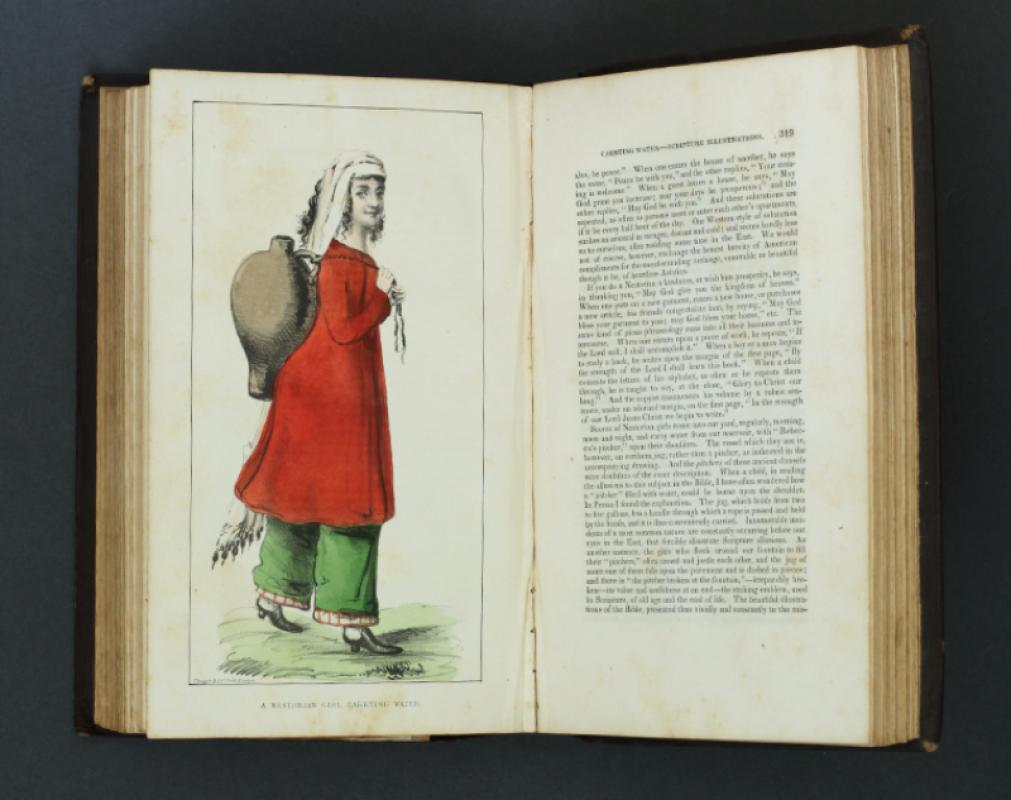
A Residence of Eight Years in Persia, among the Ne...
PERKINS, Justin
Andover, New York, etc.: Allen, Morrill & Wardwell for Allen, Morrill & Wardwell, M.W. Dodd, et al.
£875.00
Offered by Type & Forme
Friends of the PBFA
Please email info@pbfa.org for more information