Storia della scultura dal suo risorgimento in Italia fino al seculo di Canova ...
Book Description
THE DEFINITIVE, REVISED AND ENLARGED, SECOND EDITION OF CICOGNARA’S ‘MOST IMPORTANT WORK’, COMPLETE WITH THE UNCOMMON FOLIO VOLUME OF PLATES
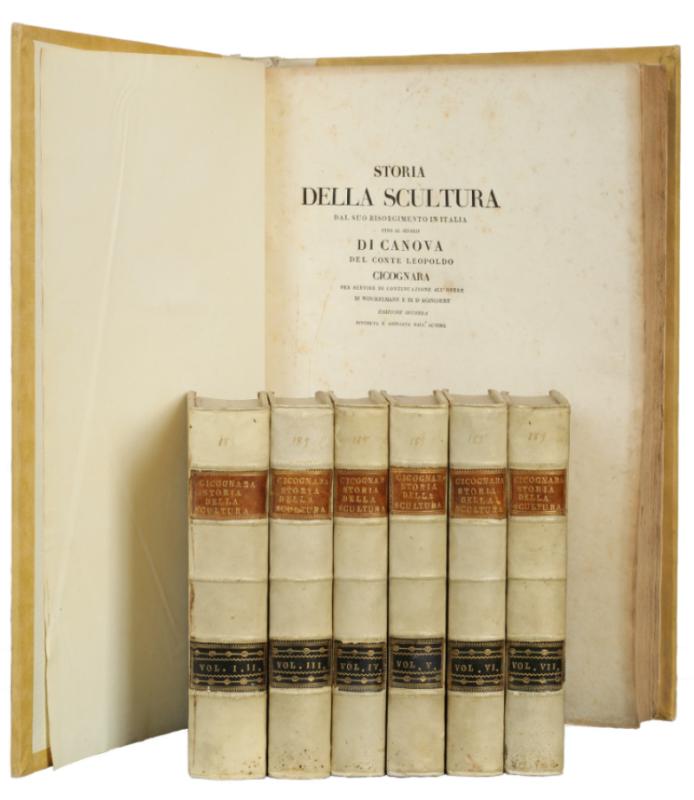
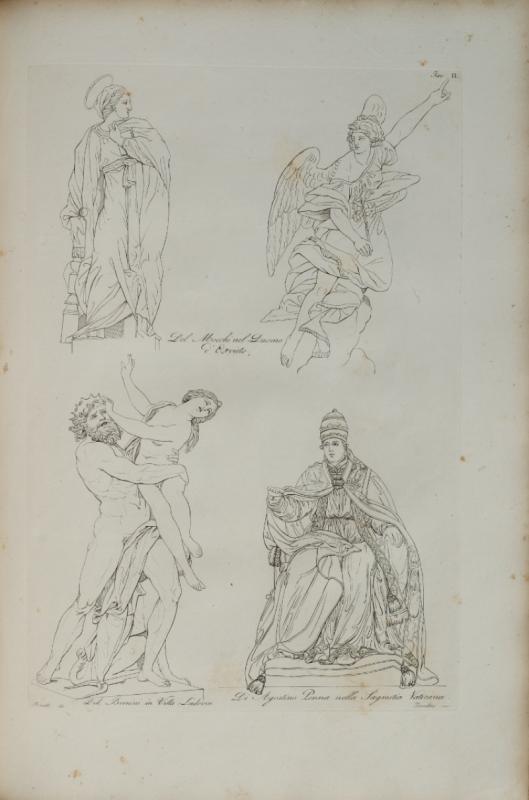
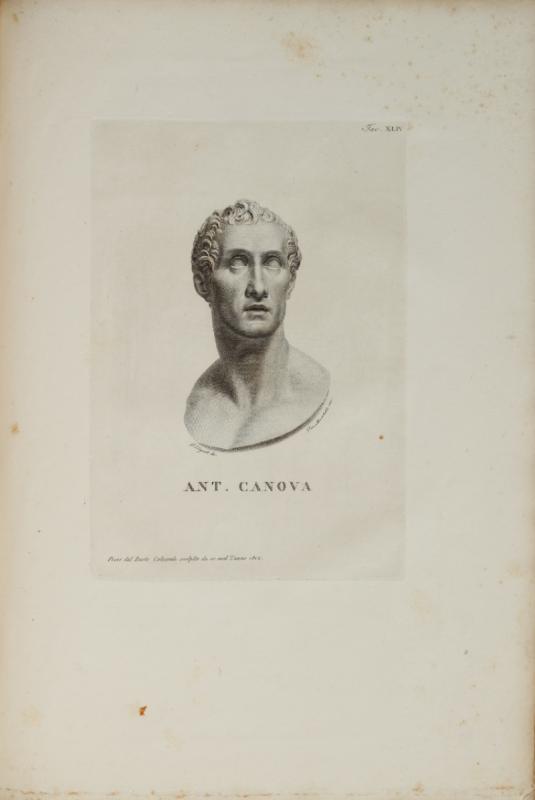
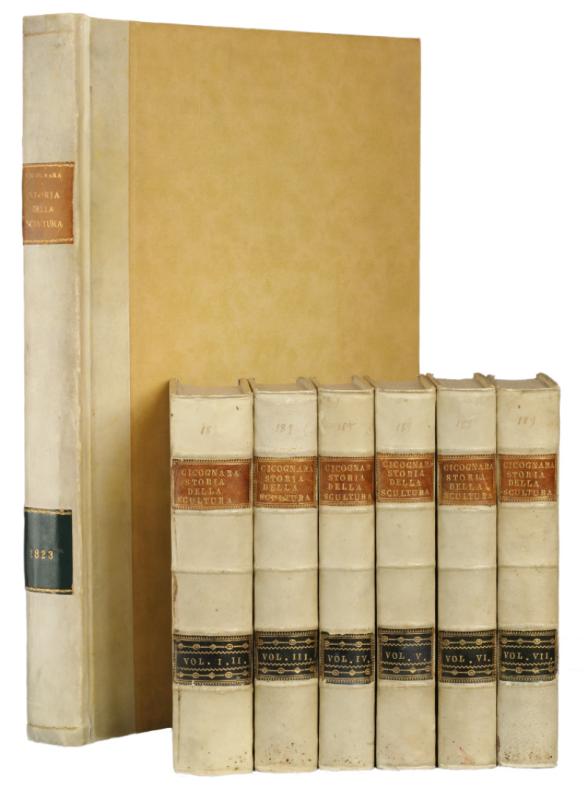
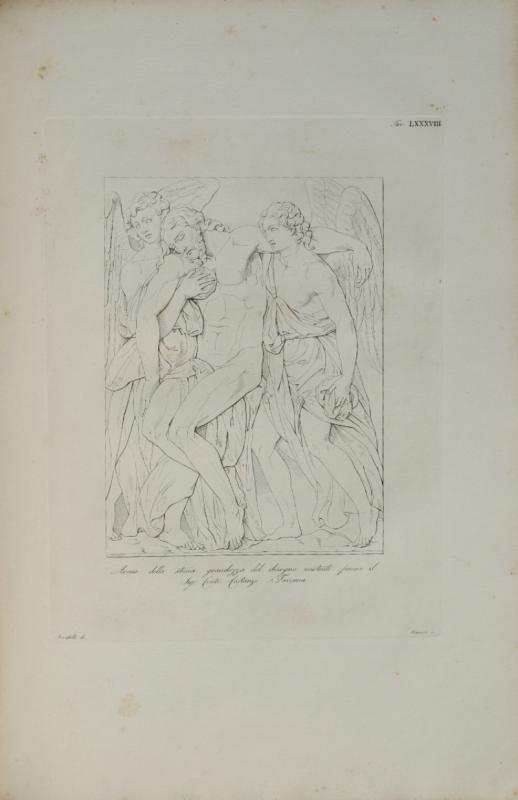
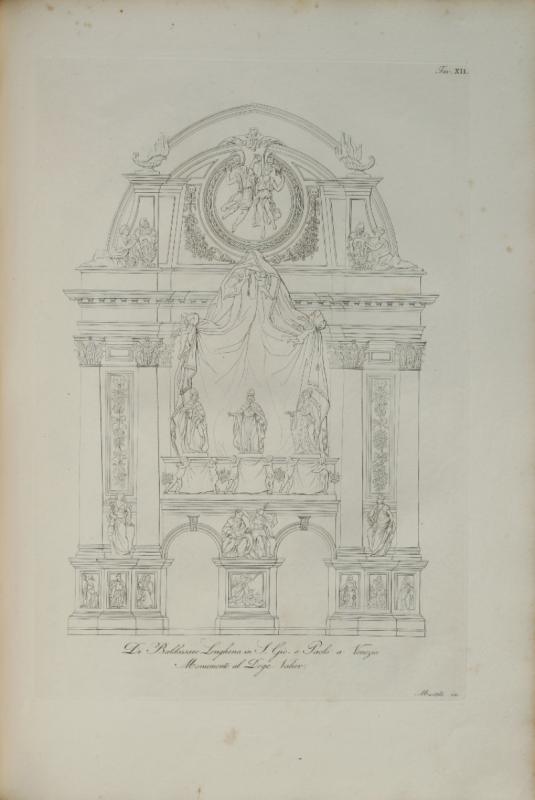
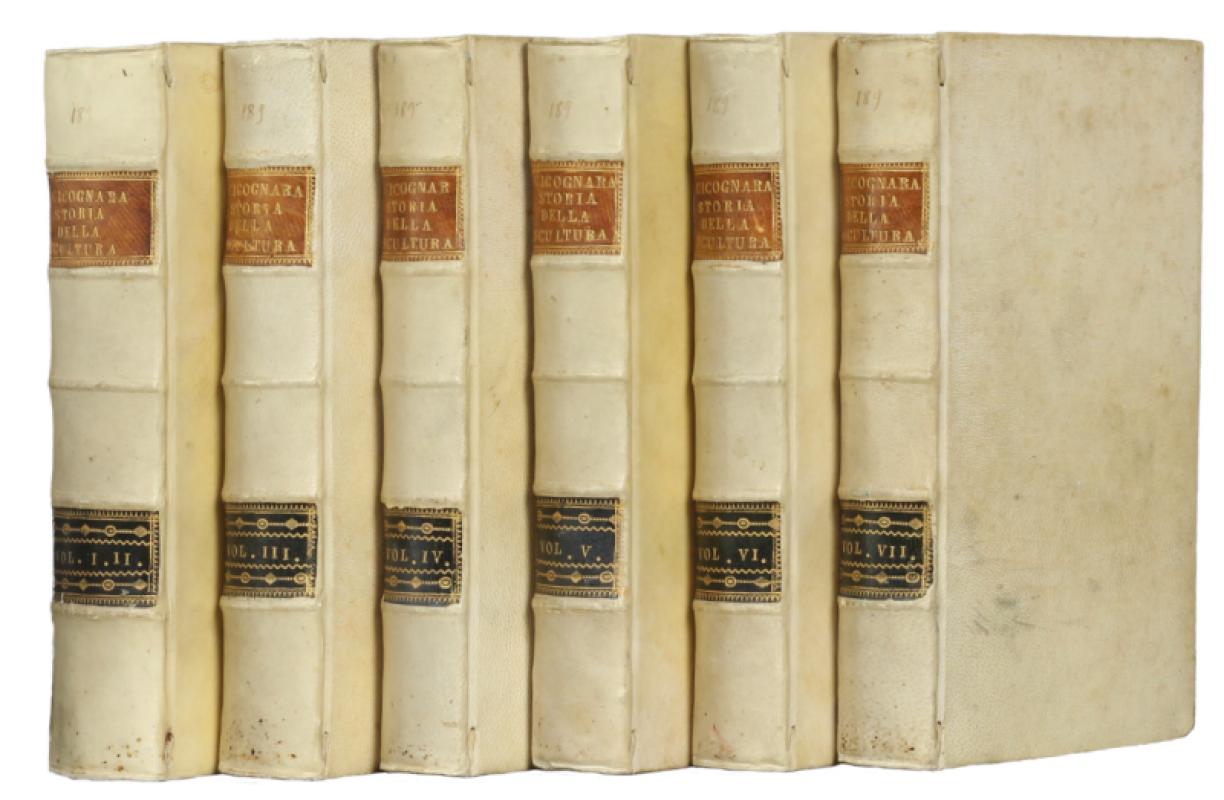
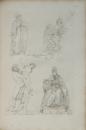
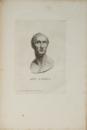
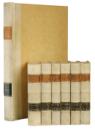
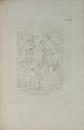
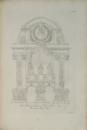
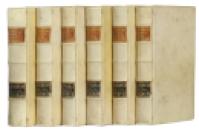
TEXT VOLS: 7 volumes bound in 6, octavo (218 x 132mm, text vols) pp. I: 324; II: 290; III: 492; IV: 451, [1 (index)]; V: 549, [1 (index)], [2 (final blank l. 35/4)]; VI: 438, [2 (index, verso blank)]; VII: 448. Engraved portrait frontispiece by Giovanni Folo in vol. I. (Some light spotting and occasional light marking, even, generally light, offsetting on text, occasional historic wax- or scorch-marks, a few marginal paper flaws or tears, that on VII, 15/3 touching text, [?]bound without final ll. I, 20/10 and II, 19/2.) Contemporary Italian vellum, spines divided into compartments by raised bands and with gilt morocco lettering-pieces in 2. (Spines slightly faded, some light marking, extremities slightly rubbed and bumped, small and superficial wormholes on one board.) Provenance: contemporary Italian bookseller’s price, denominated in scudi, on upper pastedowns for the 7 text vols bound in 6 – early manuscript [?]pressmark ‘189’ at head of spines – ‘V.L’ (19th-century inkstamps on titles) – Santa Maria della Vittoria, Rome (inkstamps ‘Biblioth. Carmelit. in S. Ma de Victoria’ on titles). ¶¶ PLATE VOL.: folio (440 x 305mm), pp. [2 (title, verso blank)]. 185 engraved plates by Antonio Bernatti, Giuseppe Dala, Benedetto Musitelli, et al. after Girolamo Baruffaldi, Tommaso Minardi, Francesco Nenci, Michele Ridolfi, Luigi Zandomeneghi, et al., numbered in 3 series I-XLIII, I-XC, and I-LII. (Some variable spotting and offsetting, a few marginal chips or tears, occasional historic wax- or scorch-marks.) Late-20th-century vellum-backed boards in the style of the text volumes, spine decorated with gilt rolls at head and foot, 2 gilt morocco lettering-pieces. (Some light marking, extremities slightly rubbed and bumped.) ¶¶¶
Dealer Notes
Between 1813 and 1818 Cicognara published the three folio volumes of ‘his most important work, Storia della scultura, tracing the evolution of Italian sculpture from the point at which Winckelmann and Séroux d’Agincourt had terminated their study and demonstrating the links between artistic, literary and political phenomena. It is not a collection of artists’ biographies in the style of Vasari, but a fresh description of a historical period that encompasses both Early Italian art and the minor arts. He open-mindedly took into account the writings of controversial authors such as Pierre François Hugues d’Hancarville, Edward Gibbon [...] and Charles-François Dupuis [...]. The work is subdivided into five sections – Rebirth, Progress, Perfection, Corruption and the Status Quo – each dominated by an artistic personality (Nicolò Pisano, Donatello, Michelangelo, Bernini and Canova respectively)’ (‘Grove Art Online’). ¶¶
A few years after the final volume of the first edition appeared, Cicognara began work on this second edition, an undertaking which (as he explains in his preface) permitted him to take account of the opinions and criticisms voiced about his book and to produce a revised, corrected, and enlarged edition. The second edition was evidently well received, and at least some of the text volumes were reissued with the dates on the title-pages amended to reflect this (for example, volume I was first published in 1823 but the copy of volume I in this set is dated 1824). As a consequence of the reprinting of text volumes, sets of the second edition of Storia della scultura in early bindings with mixed issues of the text volumes are known, including the present set, where the first and fifth volumes are second (or later) issues dated 1824 and 1825 respectively (rather than 1823 and 1824). This second edition is Cicognara’s final and definitive text, and it remains a sought-after work; for example, Arntzen and Rainwater wrote that the ‘information in this early history of Italian sculpture is still useful’ while Glass judges that the ‘second edition is an interesting summary reflecting the state of knowledge of Romanesque sculpture in the early nineteenth century’. ¶¶
This set of text volumes was one of a group of works with the 19th-century ownership stamp ‘V.L’ which subsequently passed into the library of the Discalced Carmelite conventual church Santa Maria della Vittoria in Rome (for other examples, see the second volume of Roberto Bellarmino’s Disputationum de controversiis Christianae fidei adversus huius temporis haereticos (Venice, 1721), held by the Università degli Studi Firenze, and Giovanni Francesco Cecconi’s Il Sacro rito di consacrare le chiese (Rome, 1728), held by the Stiftung Bibliothek Werner Oechslin, Einsiedeln). Santa Maria della Vittoria was built in the early 17th century by Carlo Maderno, and one of the most notable works of art it houses is Gian Lorenzo Bernini’s sculptural group ‘The Ecstasy of Saint Teresa of Avila’ (1647-1652), which is discussed by Cicognara (vol. VI, pp. 136-137) and illustrated in plate 3, IV. Interestingly, the 19th-century Italian bookseller’s price for the text volumes alone suggests that the folio volume of plates were sold separately, and the disparity in format between the text volumes and the plate volume makes it more likely that the two would be inadvertently separated; certainly, it is uncommon to find sets of the second edition of Storia della scultura complete with the folio plate volume, as here. ¶¶
E. Arntzen and R. Rainwater, Guide to the Literature of Art History, H 85; J.-C. Brunet, Manuel, II, col. 65; D.F. Glass, Italian Romanesque Sculpture, IV, 1; E. Steinmann and R. Wittkower, Michelangelo Bibliographie. I: 1510-1927 (1967), 467. ¶¶¶
To see a fully formatted version of this description, please visit our website: www.typeandforme.com, where this set may also be purchased. Please do not hesitate to contact us with any enquiries.
Other books
If you liked the book you've just seen, you might be interested in other books from the same dealer below.


Last Orders [first edition, first issue, signed]
SWIFT, Graham Colin
London: Mackays of Chatham plc for Picador
£75.00
Offered by Type & Forme
The Day’s Work
KIPLING, Joseph Rudyard
London: R. & R. Clark, Limited for Macmillan and Co., Limited
£37.50
Offered by Type & Forme
Palaeography and the Practical Study of Court Hand
JENKINSON, Charles Hilary
Cambridge: John Clay at The University Press
£49.50
Offered by Type & Forme
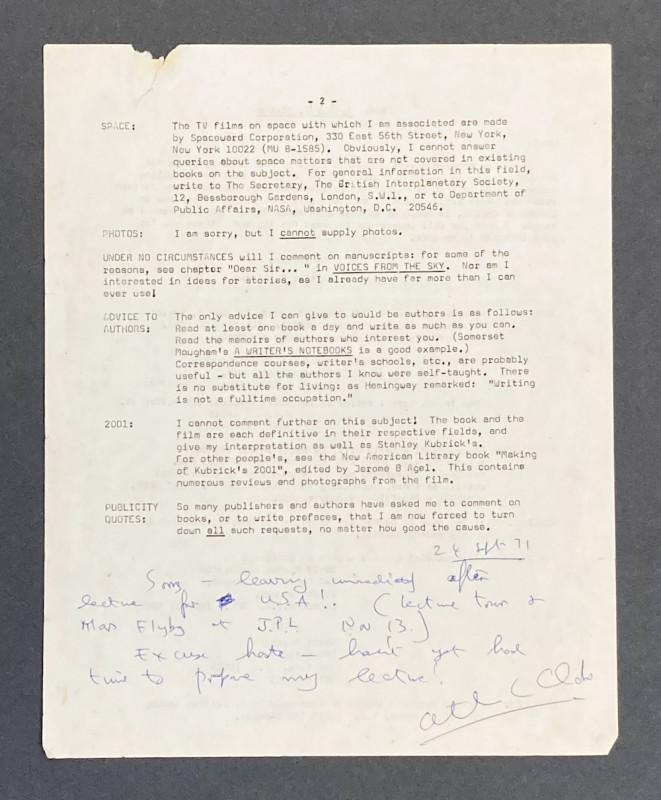
Letter anticipating the Mars flyby of Mariner 9, 1...
CLARKE, Sir Arthur Charles
[s.l.]
£395.00
Offered by Type & Forme
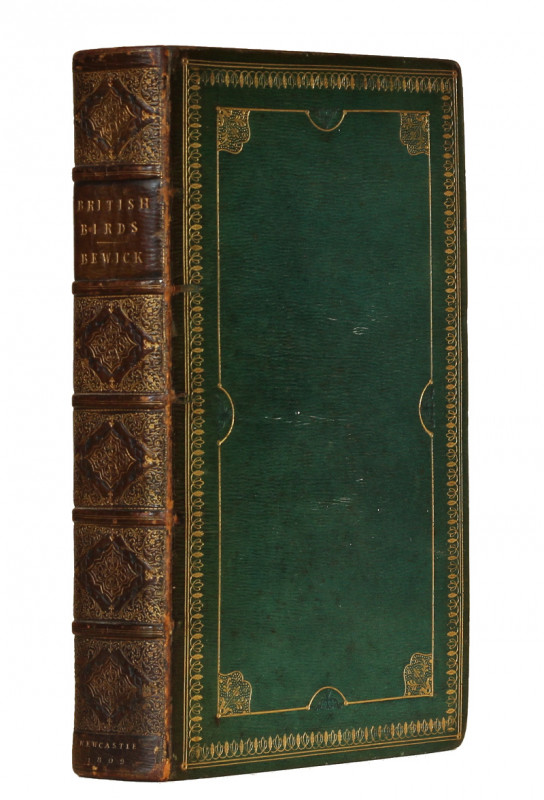
A History of British Birds ...
BEWICK, Thomas
Newcastle: Edward Walker for T. Bewick ‘sold by him, and Longman and Co., London’
£695.00
Offered by Type & Forme
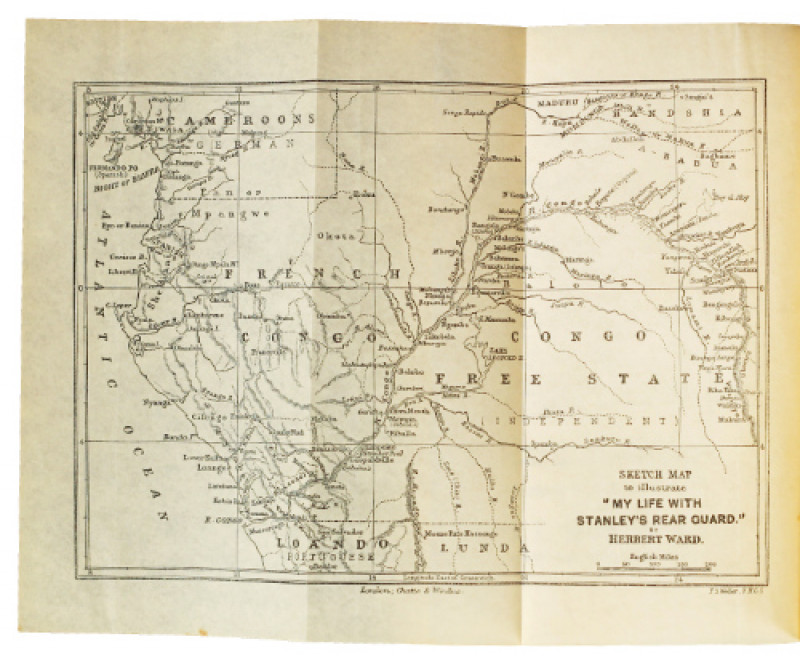
My Life with Stanley’s Rear Guard [from the librar...
WARD, Herbert
New York: Jenkins & McCowan for Charles L. Webster & Company
£195.00
Offered by Type & Forme
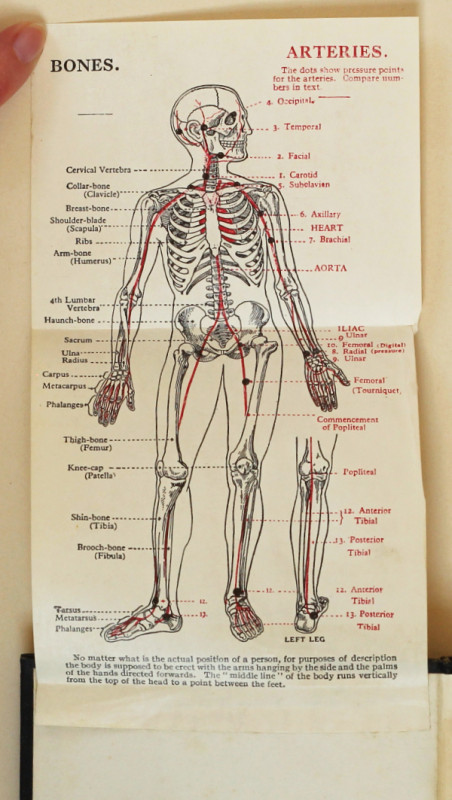
First Aid to the Injured. The Authorised Textbook...
[CANTLIE, Sir James, et al.]
London: The St. John Ambulance Association
£19.50
Offered by Type & Forme
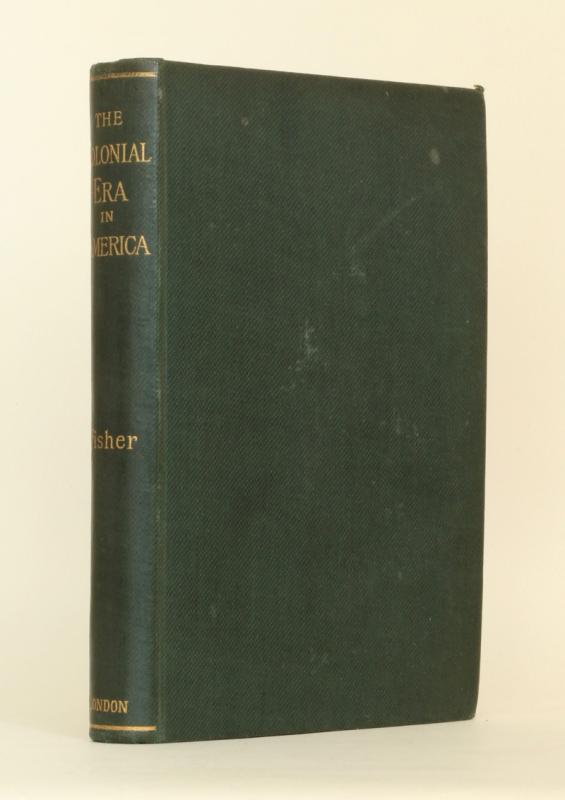
The Colonial Era in America.
FISHER, George Park.
London: William Clowes and Sons. Limited for Sampson, Low, Marston & Company Limited.
£75.00
Offered by Type & Forme

From Pole to Pole: Roald Amundsen’s Journey in Fli...
AMUNDSEN, Roald Engelbregt Gravning – Garth James CAMERON
Barnsley: Gutenberg Press Ltd for Pen and Sword Discovery
£12.50
Offered by Type & Forme
Friends of the PBFA
Please email info@pbfa.org for more information