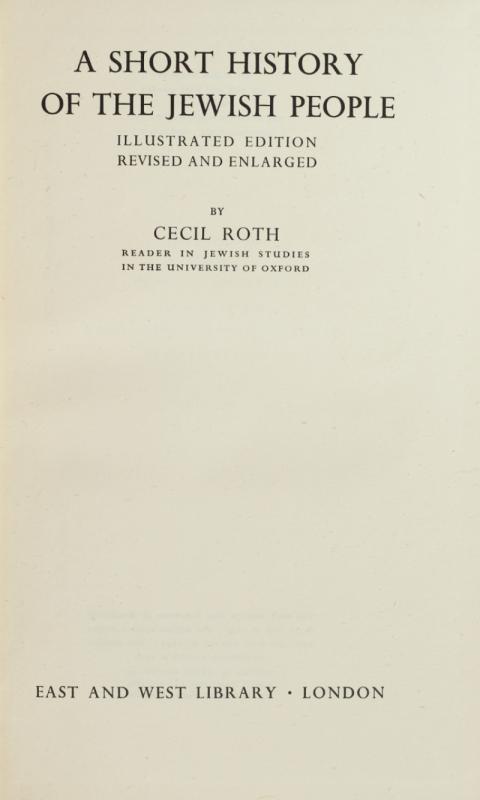
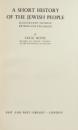
A Short History of the Jewish People. Illustrated Edition, Revised and Enlarged



Book Description
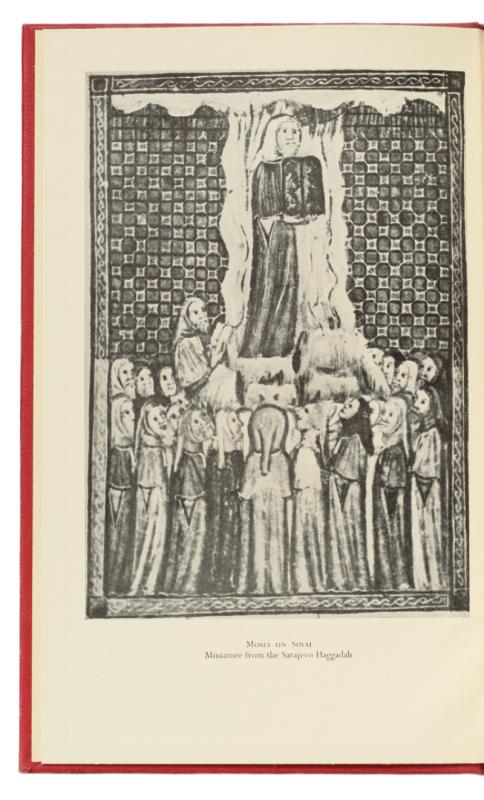
Octavo (244 x 151mm), pp. xvi, [2 (acknowledgements, illustration)], 470, [2 (final blank)]. Half-tone frontispiece with half-title on verso, and 44 half-tone plates with illustrations recto-and-verso. Illustrations and maps in the text, some full-page. (A few light marks, soft crease on corners of final ll.) Original red cloth, upper board lettered in gilt, spine lettered and decorated in gilt, top edges gilt, slipcase. (Spine slightly faded, extremities minimally rubbed, slipcase slightly marked and darkened.) A very good copy of the signed ‘edition de luxe’, retaining the slipcase. Provenance: Henry Sotheran Ltd, London (20th-century bookseller’s ticket on upper pastedown). ¶¶¶
Dealer Notes
The first edition of A Short History of the Jewish People was published in 1936 and was intended for a popular audience (Roth’s definitive History of the Jews in England was published some years later in 1941). A second edition of A Short History of the Jewish People appeared in 1943, which had been revised and slightly enlarged to include the years to the outbreak of World War II in 1939, and this first illustrated edition was published in both de luxe signed and trade issues in 1948. ¶¶
In his ‘Preface to the Illustrated Edition’ dated 1947, Roth writes that ‘[t]his work was originally published only ten years ago, but in a world entirely different from the world of today. At that time, it was possible to regard the rise of the Nazis to power in Germany merely as an exceptionally unpleasant episode. It was impossible to foretell that the result was to be the utter overwhelming, and almost extermination, of European Jewry. For this new edition, a further section has been written epitomising the unhappy history of the past few years. [...] The whole text has been revised and corrected in the light of ten years’ reading and research. There are some stylistic changes, a few additions, an entirely new Bibliography’ (p. vi). ¶¶
The preface records that ‘the revision has been a bitter task. The work was written in the first instance in an optimistic spirit, reflected in an Epilogue (now omitted) which at present seems grotesquely antiquated. For the author was brought up to believe that persecution belonged to the past; that Jewish emancipation in the Occident was final; that notwithstanding local relapses the world had progressed out of barbarism; that a monument preserved from antiquity might be considered, barring accident, safe for all time; that massacres were out of the question in modem society; that the great mass of European Jewry was settled in Europe for good, unless it were slowly dissolved by emigration or assimilation. [...] It was bitter for the Author to find that he had referred to medieval massacres of the Jews as unexampled in history, when in recent years they have been exceeded a hundred- or even a thousand-fold. Centuries-old tranquillity in country after country has proved to be the prelude to unmitigated disaster in our own day. The martyrdom of the Jews in the Ghetto period was paradise as compared with the indescribable horrors of the decade of Nazi domination’ (loc. cit.). ¶¶
After explaining that to treat the preceding decade fully would require ‘a volume many times greater than the whole of this work’, Roth concludes with the words ‘[t]he happenings in German-occupied territory from 1939 to 1945 are not an episode, but the most important event in all Jewish history during the past nineteen centuries at least. When I wrote of European Jewry ten years ago, I was dealing with a healthy living organism; today it is a charnel-house. Jewish history must be regarded henceforth, unhappily, in a completely different light. Perhaps nevertheless this volume benefits from its deficiencies; for the full history of the Jews in our time is too agonising to tell’ (pp.vi-vii). ¶¶
O.K. Rabinowicz, ‘A Bibliography of the Writings of Cecil Roth’ in J.M. Shaftesley, Remember the Days (1966), no. 328. ¶¶¶
To see a fully formatted version of this description, please visit our website: www.typeandforme.com, where this book may also be purchased. Please do not hesitate to contact us with any enquiries.
Other books
If you liked the book you've just seen, you might be interested in other books from the same dealer below.

Dark Safari: The Life behind the Legend of Henry M...
BIERMAN, John David
London: St Edmundsbury Press for Hodder & Stoughton
£19.50
Offered by Type & Forme
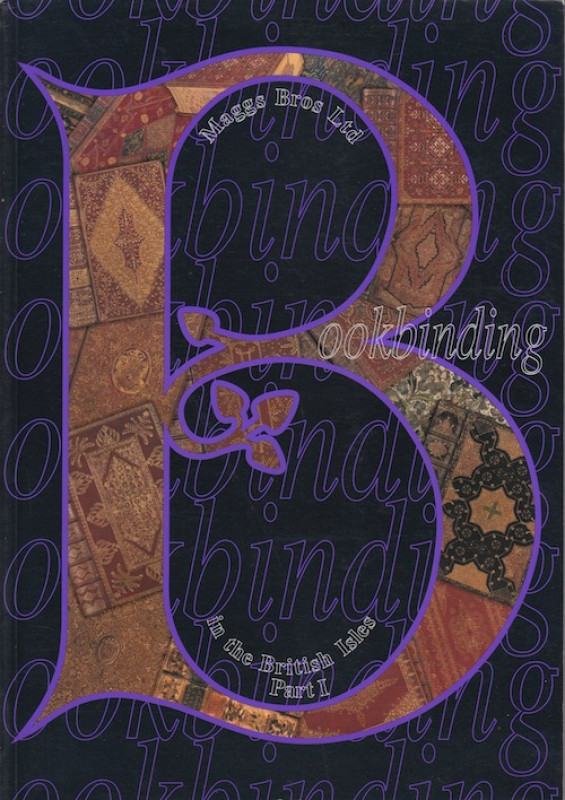
Bookbinding in the British Isles Sixteenth to Twen...
MAGGS BROTHERS LTD
London: B.A.S. Printers Limited for Maggs Bros Ltd
£79.50
Offered by Type & Forme

The Man with the Golden Gun
FLEMING, Ian Lancaster
London: Richard Clay (The Chaucer Press), Ltd for Jonathan Cape
£195.00
Offered by Type & Forme

'Plate 89: Acacia Legnota, Pedley, Mimosa anceps (...
PARKINSON, Sydney and Frederick Polydore NODDER (artist), Gerald SIBELIUS (engraver).
London: Alecto Historical Editions in association with the British Museum (Natural History)
£495.00
Offered by Type & Forme
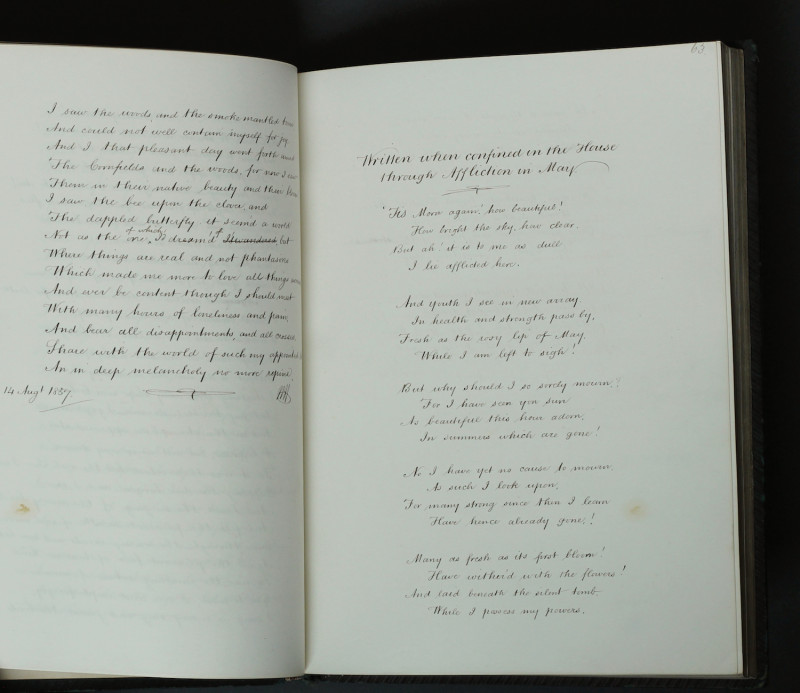
M.S. Poems [titled thus on spine]
‘H, W’ [?William HOWARTH]
[?Sheffield]
£495.00
Offered by Type & Forme
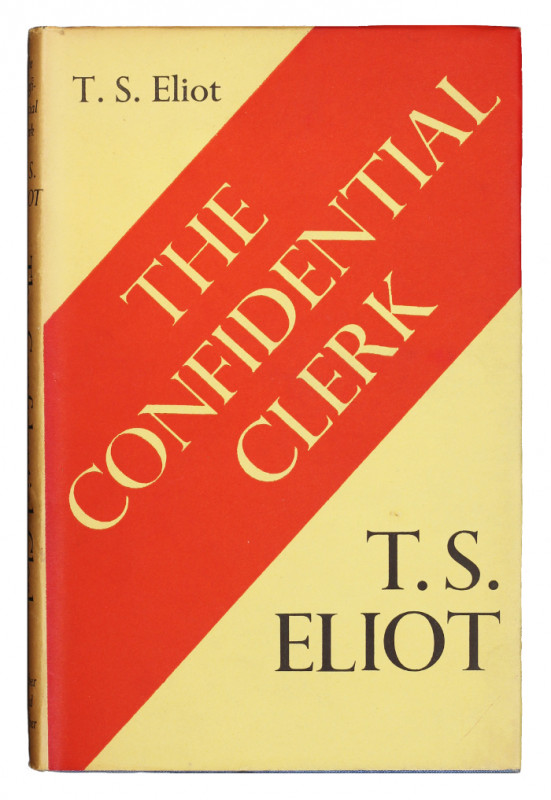
The Confidential Clerk. A Play
ELIOT, Thomas Stearns
London: R. MacLehose and Company Limited, The University Press Glasgow for Faber and Faber
£95.00
Offered by Type & Forme
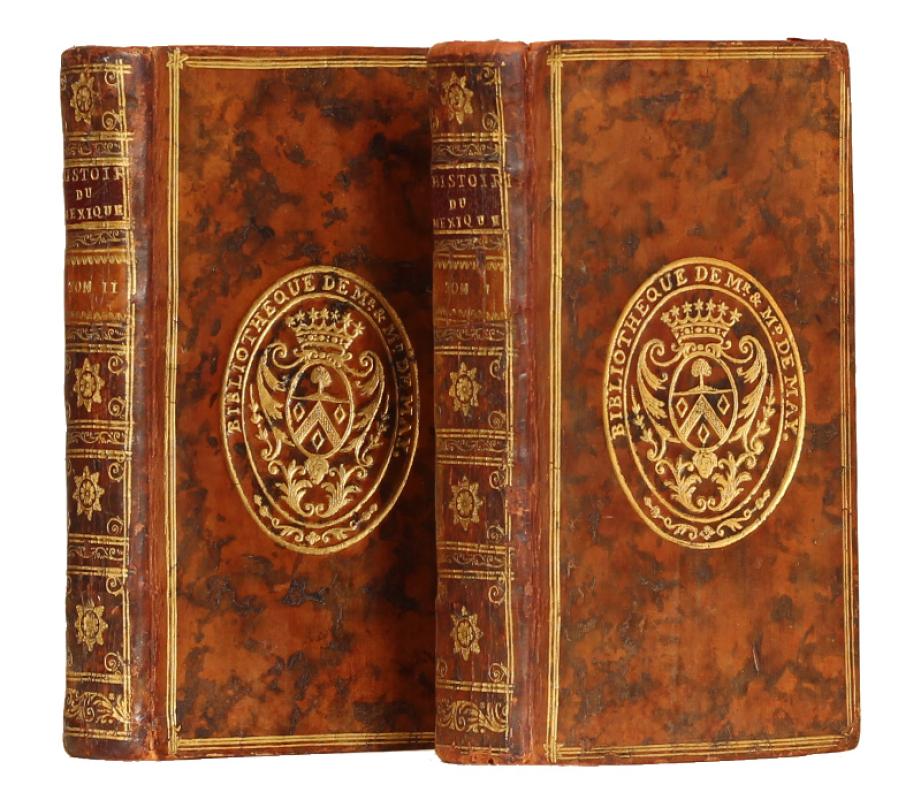
Histoire de la conqueste du Mexique... [contempora...
SOLÍS Y RIBADENEYRA, Antonio de
Paris: La Compagnie des Libraires
£795.00
Offered by Type & Forme

Evolution in Mind. An Introduction to Evolutionary...
PLOTKIN, Henry
London: Clays Ltd, St Ives plc for Penguin Books
£4.95
Offered by Type & Forme

Quiet Hours with Nature ... Illustrated by Theo. C...
BRIGHTWEN, Elizabeth (‘Eliza’)
London: Unwin Brothers, Limited, The Gresham Press for T. Fisher Unwin
£37.50
Offered by Type & Forme
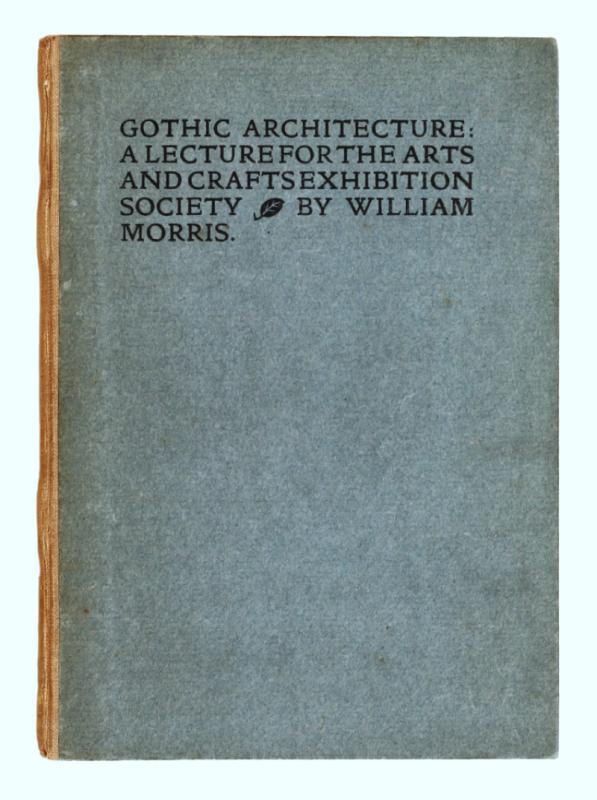
Gothic Architecture: A Lecture for the Arts and Cr...
MORRIS, William
Hammersmith: ‘printed by the Kelmscott Press during the Arts and Crafts Exhibition at the New Gallery [...]. Sold by William Morris, Kelmscott Press’
£695.00
Offered by Type & Forme
Friends of the PBFA
Please email info@pbfa.org for more information