1839- Three Victorian Passports - See Video - Grand Tour Europe - Border Stamps. Follow link for details on eBay. https://www.ebay.co.uk/itm/236838190482
Book Description
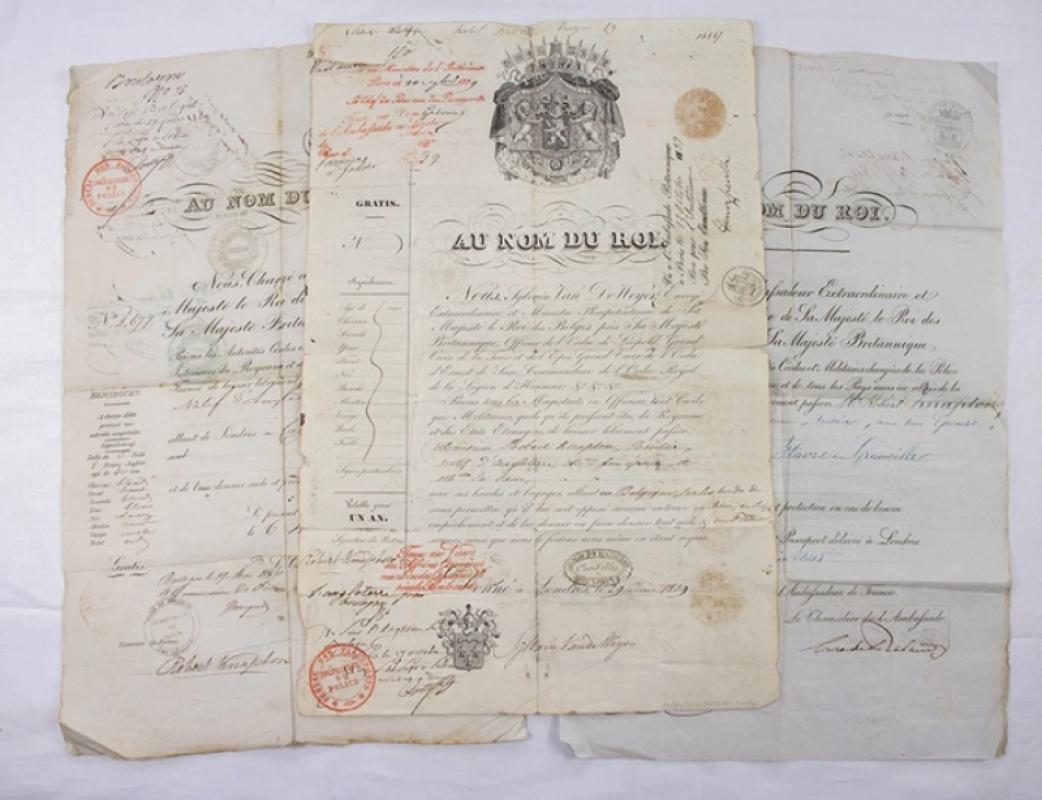
A highly evocative and unusually rich group of three original Victorian passports / continental travel documents issued in London for Robert Knapton, an English traveller whose repeated journeys through Europe are vividly preserved through a remarkable accumulation of official endorsements, border controls, municipal visas, police inspections, and diplomatic authorisations.
Far more than decorative survivals, these are true working travel documents that bear witness to the bureaucratic complexity of European movement in the decades before modern passport standardisation. Together they preserve the practical reality of nineteenth-century cross-border travel: repeated inspections, route validations, police permissions, municipal certifications, and handwritten transit notes made as the bearer progressed from place to place.
The earliest and clearest of the group is a French passport issued in London under the heading Au Nom du Roi, dated 6 May 1839, authorising Knapton and his wife to travel from London to Calais or Boulogne. Particularly appealing is the survival of the bearer’s physical description in the left-hand identification panel, recording him in period anthropometric detail: 42 years of age, approximately 5 feet 8 inches, with blond hair, blue eyes, a long nose, and an oval face.
A second and especially impressive document is the Belgian passport issued in London in June 1839, printed with a large crowned coat of arms and signed in the name of Sylvain Van de Weyer, the important Belgian statesman and diplomat who served as Minister in London. This passport appears to extend the journey beyond a simple Channel crossing and strongly suggests that Knapton was travelling not merely as a tourist but on a more substantial continental route, possibly with wider family accompaniment.
The third passport, issued in 1845, records a later journey and is especially attractive for the way it demonstrates repeated travel over a span of years. This time the route is given as from London to Le Havre or Granville, indicating a different Channel itinerary and suggesting a further organised tour or extended family/business journey.
Dealer Notes
What makes this group especially desirable is the extraordinary density of official manuscript endorsements and stamped border notations scattered across all three documents. Among the more legible and interesting are references to Boulogne, Calais, Paris, Nantes, Belgium, Liège, Coblentz / Coblenz, and probably Geneva, as well as later route evidence pointing toward Le Havre, Granville, Avranches, and Jersey. These endorsements collectively transform the passports into a genuine documentary record of continental movement across France, Belgium, parts of the German states / Prussia, and likely Switzerland.
Particularly attractive are the numerous official control marks, including a bold red “Vu des Passeports / Préfecture de Police” stamp, manuscript notes indicating onward permission into Belgium, and several municipal or police seals that speak directly to the tightly regulated nature of pre-modern European travel. The cumulative effect is visually striking and historically rich.
The named bearer, Robert Knapton, appears from surviving records to have been a respectable English provincial businessman rather than a diplomat or aristocratic tourist, which gives the group an especially human and socially interesting dimension. These documents likely record the real movements of a middling English traveller and his family through the bureaucratic corridors of nineteenth-century Europe.
Surviving groups of multiple passports to the same named individual, especially with such a heavy concentration of stamps, visas, police endorsements, and route annotations, are increasingly sought after by collectors of passport history, travel ephemera, continental Grand Tour material, border history, and nineteenth-century documentary archives.
A visually compelling and historically rewarding group of Victorian travel documents, rich in manuscript evidence and unusually strong in narrative appeal.
Particularly attractive are the numerous official control marks, including a bold red “Vu des Passeports / Préfecture de Police” stamp, manuscript notes indicating onward permission into Belgium, and several municipal or police seals that speak directly to the tightly regulated nature of pre-modern European travel. The cumulative effect is visually striking and historically rich.
The named bearer, Robert Knapton, appears from surviving records to have been a respectable English provincial businessman rather than a diplomat or aristocratic tourist, which gives the group an especially human and socially interesting dimension. These documents likely record the real movements of a middling English traveller and his family through the bureaucratic corridors of nineteenth-century Europe.
Surviving groups of multiple passports to the same named individual, especially with such a heavy concentration of stamps, visas, police endorsements, and route annotations, are increasingly sought after by collectors of passport history, travel ephemera, continental Grand Tour material, border history, and nineteenth-century documentary archives.
A visually compelling and historically rewarding group of Victorian travel documents, rich in manuscript evidence and unusually strong in narrative appeal.
Author
Official diplomatic and governmental passport documents issued for Robert Knapton
Date
1839 and 1845.
Binding
Loose as issued.
Publisher
French and Belgian diplomatic authorities in London.
Illustrator
Printed royal arms, decorative engraved passport headings, official seals, numerous manuscript visas and transit endorsements throughout
Condition
Good to Very Good overall for working travel documents of this nature.
Pages
3 large single-sheet folding passport documents.
Other books
If you liked the book you've just seen, you might be interested in other books from the same dealer below.
1839- Three Victorian Passports - See Video - Gran...
Official diplomatic and governmental passport documents issued for Robert Knapton
French and Belgian diplomatic authorities in London.
£150.00
Offered by Kernoozers Ltd
The Garden Beautiful in California
Braunton, Ernest
Cultivator Publishing Co.
£40.00
Offered by Kernoozers Ltd
Friends of the PBFA
For £10 get free entry to our fairs, updates from the PBFA and more.
Please email info@pbfa.org for more information